
2025 Delphi Digital Top 10 Predictions: DeFi Evolves to DeAI; Solana to Continue Outperforming Ethereum

Original Source: Delphi Digital
Original Translation: Yuliya, PANews
In the cryptocurrency field, 2025 is considered a crucial year full of innovation and change. With continuous technological advancements and evolving market conditions, several areas are expected to witness significant breakthroughs and opportunities. From Bitcoin's continued bull market to Solana's rise, and DeFi's transformation into DeAI, the cryptocurrency market in 2025 will present unprecedented diverse trends. This article will explore the ten major market trends predicted by Delphi Digital, revealing possible future directions for the cryptocurrency industry.
1. Bitcoin (BTC) Still Has Upside Potential
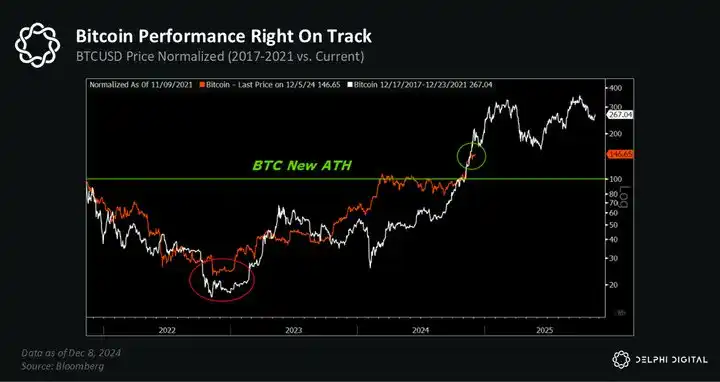
Delphi Digital's cycle model has previously predicted that Bitcoin would hit a new high in the fourth quarter of 2024. Currently, Bitcoin's trend aligns with the forecast.
· Each new all-time high has been accompanied by a monthly RSI breakout above 70, with previous bull markets usually ending only after the RSI exceeded 90.
· According to the monthly price regression channel, Bitcoin is still below the 1-2 standard deviation range from the top.
· Institutional interest growth and a relaxed regulatory environment may be the primary drivers of this bull market cycle.
2. Solana Emerges as a Key Player
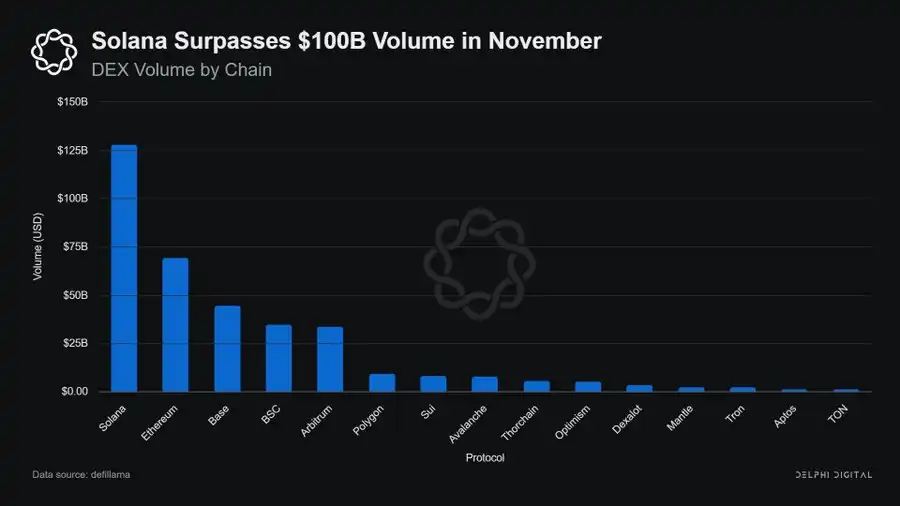
Solana will continue to outperform Ethereum, mainly due to its excellent user experience and a better content ecosystem.
· With no need for token approvals or wrapped tokens, Solana's operation is simple and intuitive.
· Solana's Solana Virtual Machine (SVM) is the fastest-growing alternative VM ecosystem, with its network effects constantly strengthening. Additionally, projects like Anza, Firedancer, and improved wallet infrastructure will further enhance the user experience.
· Solana co-founder Anatoly Yakovenko's vision is to maintain Solana's edge even in the face of increased competition by increasing bandwidth, reducing latency, and improving its scalability.
3. NFT Makes a Comeback
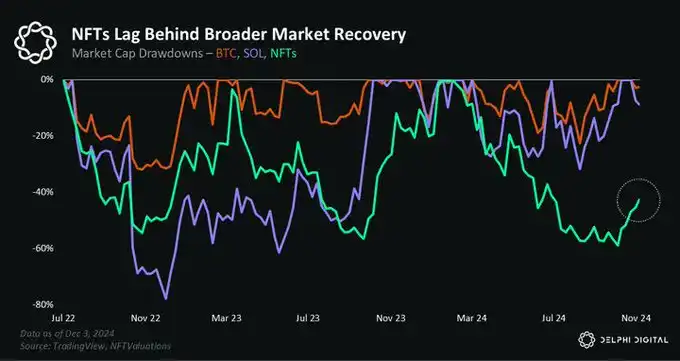
The NFT market will experience a strong resurgence that defies market sentiment and fundamentals.
· While tokenized transactions are more convenient, NFTs can achieve on-chain uniqueness coding, allowing heterogeneous assets (such as art, wine, etc.) to be NFT-ized.
· Some significant wealth creation events (like the airdrops of PudgyPenguins, Milady, and Azuki) may inspire other NFT projects to follow suit.
· NFTs are more user-friendly to retail users, suitable for showcasing culture and social status.
4. Decentralized Finance (DeFi) Evolving into DeAI
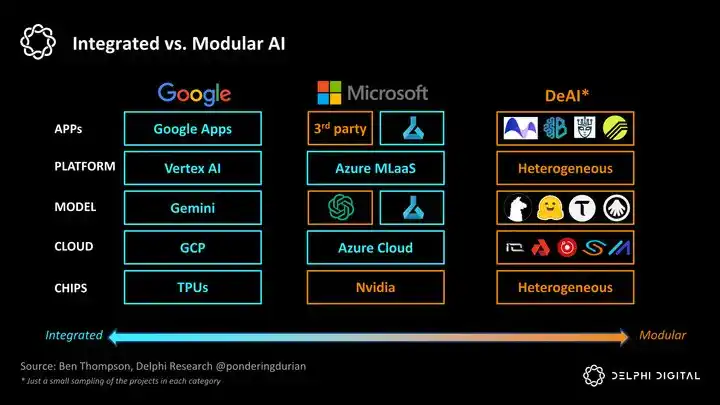
DeAI will fundamentally change the way users interact with DeFi.
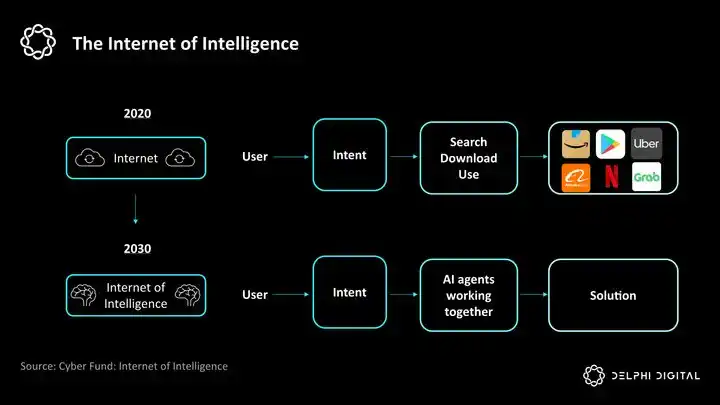
· The front-end interface will be replaced by intelligent agents, allowing users to perform transactions, currency exchanges, yield farming, etc., through natural language processing.
· In the future, most capital allocation decisions will be made by agents. griffain is a pioneer in this area, but DeAI projects like HeyAnon are rapidly emerging.
5. AI Agents Becoming Top Crypto Investors
The future of trading will be dominated by AI agents rather than human counterparts.
· Agents can monitor the market around the clock and process more data, transforming trading into a competition of computing power and unique datasets.
· By 2025, at least three agent frameworks are expected to become unicorn companies with a market cap exceeding $100 billion.
6. High Throughput Chains Driving Innovation
High throughput blockchains will bring more experimentation and opportunities in 2025.
· Notable projects to watch include Hyperliquid, Sui, and Monad, but other chains like Berachain also have potential.
· MegaETH is expected to compete for market share with layer-two networks rather than directly with layer-one networks.
7. DePin Sees a Resurgence
If a large-scale DePin project achieves self-sustainability, it could trigger a reassessment of the field and drive a "fundamentals" rebound.
· DePin has disruptive potential in areas such as wireless services (Helium), network infrastructure (DoubleZero), mapping services (Hivemapper), healthcare, and grid operations.
8. zkVM Set to Undergo Revolutionary Development
· zkVM technology will enhance interoperability among various Rollups, enabling seamless cross-chain interaction.
· zkVM will also expand the developer market, allowing developers to build zk applications using languages like Rust.
9. AI Unlocks New Opportunities for GameFi
· AI development tools will boost game developers' productivity.
· Projects like InWorldAI are developing AI-driven NPC services.
· Open-source projects such as the Virtuals.io game framework and Eliza's integration with Unreal Engine and Unity could represent a revolutionary breakthrough in the AI gaming space.
10. Consumer-Grade DeFi is the Next Blue Ocean
· By 2025, on-chain finance will comprehensively serve the crypto-native.
· zkTLS will enable bringing Web2 sensitive data on-chain while maintaining privacy, thus facilitating applications like personalized proxies and credit scoring.
· Revenue-sharing stablecoins will continue to expand, aligning incentive mechanisms better between issuers and distributors.
You may also like

WEEX Deposit/Withdrawal Dynamic Island: Your Asset Status, Always in Sight

Scaling Crypto Derivatives: The Digital Asset Infrastructure Behind High-Volume Trading
In the fast-moving digital asset ecosystem, derivatives platforms face an extreme architectural test. High-leverage futures markets demand more than just standard security—they require absolute operational precision, zero-latency matching engines, and ironclad structural scalability, all while navigating intense market volatility.
As global platforms scale to meet these demands, the industry is shifting away from rigid, monolithic setups toward a more agile, "decoupled" infrastructure philosophy.
The Blueprint for High-Volume Copy TradingFor elite global exchanges like WEEX (founded in 2018), this architectural choice becomes critical when scaling high-volume retail features like social copy trading. When thousands of users automatically mirror the real-time strategies of elite traders simultaneously, it triggers sudden, monumental spikes in concurrent transactional volume.
To prevent execution latency or settlement bottlenecks during these peak volatility events, a platform's primary engine must remain entirely dedicated to risk management, copy-trade synchronization, and order matching.
The Architectural Rule: New-generation platforms must separate front-end user execution engines from heavy backend infrastructural overhead to eliminate operational friction.
By separating these layers, platforms can maintain complete sovereignty over their trading environments and user experiences while strategically aligning with institutional-grade infrastructure ecosystems. This strategic framework allows modern exchanges to leverage advanced Digital Asset Custody infrastructure such as Cobo’s behind the scenes, ensuring that backend wallet management scales elastically alongside trading spikes.
Capitalizing on Market Momentum and 400× LeverageIn a derivatives arena where platforms offer up to 400× leverage on perpetual contracts, capital efficiency and market agility are core business metrics. To capture market momentum, an exchange needs the ability to rapidly expand its asset offerings, supporting everything from legacy crypto assets to sudden, trending altcoins across a massive library of trading pairs.
Adopting a flexible, scalable Wallet-as-a-Service (WaaS) solution such as Cobo’s could completely rewrite the development timeline for high-growth exchanges. Instead of spending months of engineering capital building out custom backend wallet architectures for every new blockchain network, platforms can deploy localized infrastructure in days.
This agility allows platforms to instantly scale their listings to over a thousand trading pairs without compromising security or delaying time-to-market. It mirrors the exact operational advantages seen during high-velocity market events, similar to how advanced wallet infrastructure empowers platforms during sudden asset surges; allowing exchanges to pass that speed and liquidity directly to their global user base.
A Mature Foundation for GrowthThe synergy between trusted infrastructure ecosystems and global trading platforms represents the natural evolution of a maturing crypto market. As WEEX continues to scale its global spot and derivatives offerings for over 6 million users, adopting robust backend paradigms proves that platforms no longer have to compromise between cutting-edge trading velocity and uncompromised structural security.

Morning Report | BitMine increased its holdings by 126,971 ETH last week; trader Eugene announced his exit from the crypto market

Wang Chuan: How can one not feel anxious after the neighbor Old Wang made thirty times profit by investing in storage stocks? (Seven) - A quarter-century cycle

Get Paid to Onboard? Try WEEX’s New Homepage with Rewards for Registration, Deposit & Trade

WEEX Custom Layout: Build Your Perfect Trading Workspace in Seconds

See “Buy Walls” & “Sell Walls” Instantly: WEEX Launches the Depth Chart for Smarter Trades

What Is Quick Trade on WEEX? 2 Ways WEEX Ends Chart-Panel Jumping
Morning News | Five major virtual asset platforms in South Korea have experienced 57 incidents of hacking and system failures in six years; Grayscale submits registration application for Canton ETF

Should we escape the peak? The principle of the tail-end market in the stock market

RootData: May 2026 Cryptocurrency Exchange Transparency Research Report

Founder of Baixing.com: My Experience with Claude Code in Fourteen Points

Yang Ge Gary: Agent Economics and AI Microeconomics
When reasoning becomes a scarce resource, who captures its value?

Jensen Huang dramatically "rescues" the South Korean stock market

Stablecoins vs Deposit Tokens: On the surface, they seem like opposing sides, but in reality, they are interconnected

Bitcoin Crash to $50,000 or Bear Trap Before $100,000? Deep Dive for WEEX Traders
How Could the SpaceX IPO Affect Bitcoin, Altcoins season, and Crypto Liquidity?
WEEX Deposit/Withdrawal Dynamic Island: Your Asset Status, Always in Sight
Scaling Crypto Derivatives: The Digital Asset Infrastructure Behind High-Volume Trading
In the fast-moving digital asset ecosystem, derivatives platforms face an extreme architectural test. High-leverage futures markets demand more than just standard security—they require absolute operational precision, zero-latency matching engines, and ironclad structural scalability, all while navigating intense market volatility.
As global platforms scale to meet these demands, the industry is shifting away from rigid, monolithic setups toward a more agile, "decoupled" infrastructure philosophy.
The Blueprint for High-Volume Copy TradingFor elite global exchanges like WEEX (founded in 2018), this architectural choice becomes critical when scaling high-volume retail features like social copy trading. When thousands of users automatically mirror the real-time strategies of elite traders simultaneously, it triggers sudden, monumental spikes in concurrent transactional volume.
To prevent execution latency or settlement bottlenecks during these peak volatility events, a platform's primary engine must remain entirely dedicated to risk management, copy-trade synchronization, and order matching.
The Architectural Rule: New-generation platforms must separate front-end user execution engines from heavy backend infrastructural overhead to eliminate operational friction.
By separating these layers, platforms can maintain complete sovereignty over their trading environments and user experiences while strategically aligning with institutional-grade infrastructure ecosystems. This strategic framework allows modern exchanges to leverage advanced Digital Asset Custody infrastructure such as Cobo’s behind the scenes, ensuring that backend wallet management scales elastically alongside trading spikes.
Capitalizing on Market Momentum and 400× LeverageIn a derivatives arena where platforms offer up to 400× leverage on perpetual contracts, capital efficiency and market agility are core business metrics. To capture market momentum, an exchange needs the ability to rapidly expand its asset offerings, supporting everything from legacy crypto assets to sudden, trending altcoins across a massive library of trading pairs.
Adopting a flexible, scalable Wallet-as-a-Service (WaaS) solution such as Cobo’s could completely rewrite the development timeline for high-growth exchanges. Instead of spending months of engineering capital building out custom backend wallet architectures for every new blockchain network, platforms can deploy localized infrastructure in days.
This agility allows platforms to instantly scale their listings to over a thousand trading pairs without compromising security or delaying time-to-market. It mirrors the exact operational advantages seen during high-velocity market events, similar to how advanced wallet infrastructure empowers platforms during sudden asset surges; allowing exchanges to pass that speed and liquidity directly to their global user base.
A Mature Foundation for GrowthThe synergy between trusted infrastructure ecosystems and global trading platforms represents the natural evolution of a maturing crypto market. As WEEX continues to scale its global spot and derivatives offerings for over 6 million users, adopting robust backend paradigms proves that platforms no longer have to compromise between cutting-edge trading velocity and uncompromised structural security.
Morning Report | BitMine increased its holdings by 126,971 ETH last week; trader Eugene announced his exit from the crypto market
Wang Chuan: How can one not feel anxious after the neighbor Old Wang made thirty times profit by investing in storage stocks? (Seven) - A quarter-century cycle
Get Paid to Onboard? Try WEEX’s New Homepage with Rewards for Registration, Deposit & Trade
WEEX Custom Layout: Build Your Perfect Trading Workspace in Seconds


