
2025 Halving Outlook: How to Avoid the Bear Trap and Capture AI Coin Alpha?





Original Article Title: Thoughts on Post-Halving Year 2025
Original Article Author: arndxt xo, plumenetwork Researcher
Original Article Translation: zhouzhou, BlockBeats
Editor's Note: This article analyzes the latest developments in Bitcoin and the crypto market. The early-year short trap led to a Bitcoin price correction, while macroeconomic factors such as inflation concerns and the rise in the US dollar index intensified market uncertainty. AI coins experienced a significant correction, but emerging AI coins such as ANON, AVA, PIPPIN showed strong performance. Meme coin FARTCOIN also attracted attention and, despite a pullback, has the potential to become a market leader. Coins like XRP benefited from Ripple's relationship with the US government, showing outstanding performance.
The following is the original content (slightly reorganized for readability):
Historically, February has been a strong month for Bitcoin performance in halving years.
2017 and 2021 Cycles: Bitcoin dropped in January and then resumed its upward trend in February. 2025 Prediction: If history repeats itself, we may see a similar uptrend this year. In the coming months, speculation about Bitcoin-related executive orders is brewing. Although unconfirmed, such events have historically had a significant impact on the market.
Industry Overview
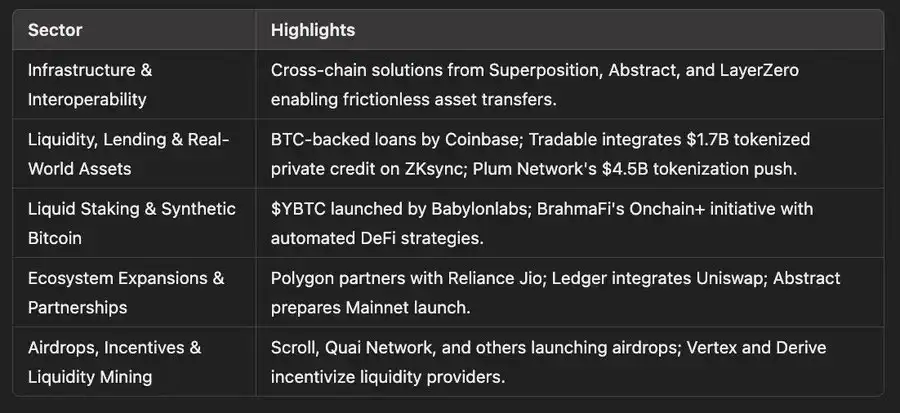
1. Infrastructure and Interoperability
Reduce network tribalism through cross-chain connections.
We are witnessing an acceleration in cross-chain development—projects like Superposition (Arbitrum L3) and Abstract (Hydra with integrated Stargate) are rolling out solutions to enhance the efficiency of asset transfers and data sharing. LayerZero is expanding its influence, allowing applications on Superposition to tap into liquidity from over 100 connected chains. Meanwhile, Arcana Network has partnered with Scroll to enable users to pay gas fees in stablecoins (USDC/USDT) on any chain, significantly streamlining the user onboarding process.
My take: This underscores the continued push for frictionless interoperability. Being able to seamlessly transfer assets and data across chains (L1 → L2 → L3) is rapidly becoming a fundamental requirement. Projects that can integrate user-friendly interfaces, gas fee abstractions, and universal bridging are poised to reduce the "network tribalism" that has historically hindered DeFi adoption. More standardization and potentially more professional L3 rollouts tailored for unique verticals (e.g., gaming, RWA, institutional DeFi) are expected.
2. Liquidity, Lending, and Real-World Assets
The Holy Grail of the Credit and Lending Ecosystem.
What Happened:
· Coinbase launched BTC-backed loans for U.S. users, providing a more mainstream audience with the ability to leverage their Bitcoin.
· Tradable integrated with ZKsync, bringing $1.7 billion worth of Real-World Asset (RWA) collateral to the network, showcasing how institutional-grade products are further penetrating DeFi.
· plumenetwork has tokenized over $4.5 billion in assets, achieved a $64 million TVL before the network even launched, and introduced a $25 million RWAfi Ecosystem Fund.
My Take: The blurred boundary between CeFi and DeFi is a prime example of this industry maturing. Coinbase's foray into crypto lending demonstrates centralized exchanges willing to offer products typically associated with DeFi platforms—potentially cannibalizing DeFi's direct user base but also validating on-chain lending as a key financial tool. Furthermore, RWA integration remains the "Holy Grail," linking traditional finance with on-chain liquidity. If this trend persists, DeFi could see stronger yields, deeper liquidity, and increased institutional trust, although regulatory oversight could also tighten.
3. Liquid Staking and Synthetic Bitcoin
Innovations in Staking Mechanisms.
What Happened:
· babylonlabs.io introduced YBTC, a 1:1 Bitcoin-backed liquid staking token, which has been integrated with pSTAKE.
· BrahmaFi launched the Onchain+ plan, bundling multi-chain strategies and an AI agent (ConsoleKit) for automated DeFi operations.
My Take: Liquid staking has proven to be a means of unlocking additional rewards for stakers without sacrificing liquidity. By tokenizing staked assets (such as BTC, ETH, etc.), DeFi participants can use them as collateral or trade freely. This "dual yield" approach—earning staking rewards while potentially gaining DeFi yields—is likely to continue accelerating. However, there are inherent risks: the more times assets are "liquidly staked," the deeper the system's complexity. Protocols must remain transparent and undergo thorough audits to prevent hidden leverage from destabilizing the system's integrity.
4. Ecosystem Expansion and Strategic Partnerships
Significant user adoption efforts and enterprise collaborations.
What Happened:
· Polygon Labs partnered with India's largest telecom company, Reliance Jio (with 450 million users), to integrate blockchain solutions into the Jio app.
· Ledger integrated Uniswap into Ledger Live Desktop, enhancing the user experience for hardware wallet enthusiasts.
Abstract prepared for its mainnet, hinting at a wave of new cross-chain products coming soon.
5. Airdrops, Incentives, and Liquidity Mining
User adoption battleground.
What Happened:
· Projects like Scroll, Quai Network, Fuel, Bubblemaps, and many others are launching airdrops or continuing reward seasons, each with its own community participation criteria.
· Protocols like Vertex (2.1M SEI tokens) and Derive (offering 2 million DRV tokens to liquidity providers) continue to incentivize user participation, while Nodepay and Solayer offer pre-claim processes or public sales with instant TGE distribution.
My Take: Airdrops have proven to be an effective means of paving the way for an initial user base, but they are also becoming a "must-have" competitive strategy for new protocols. With so many projects offering incentives, user fatigue could become an issue. The key for projects is to provide real utility rather than relying solely on "incentive chasing." Over time, protocols need to balance incentives with sustainable tokenomics. The ideal state is to attract new users through rewards while providing them with real product value to retain them.
Narrative Overview
BTC Price Trends and Macroeconomic Impacts
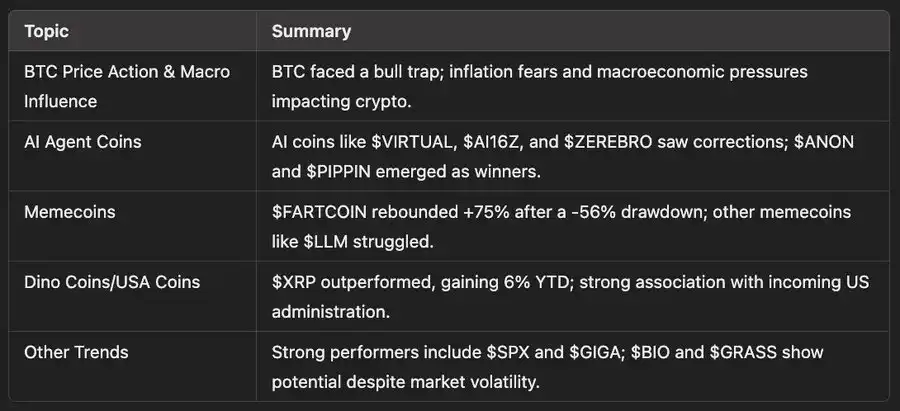
The first Monday of the year marked a significant short squeeze, with Bitcoin surging after the New York market opening, Coinbase trading at a premium, leading many to believe it was the start of a bull market cycle. However, this proved to be a false signal as BTC stalled the next day and saw a steep decline, dragging down other altcoins with it.
Key Macroeconomic Factors Driving Uncertainty
·Inflation Concern: The strong Labor Market data on January 10th (NFP Report) hinted at potential inflationary pressure, which could lead to a reduced expectation of rate cuts — a bearish signal for the stock market and cryptocurrency.
·US Dollar Index (DXY): Reached a new high of 110.
·10-Year Treasury Yield: Rose from 4.6% to 4.8% (YTD).
·S&P 500 Index: Retested pre-election prices.
AI Agent Coin: Correction and Opportunity
The AI Agent coins that have recently dominated market attention have experienced significant corrections:
·VIRTUAL: Plunged -57% from a peak of $52 billion. AI16Z: Dropped -63% from a peak of $25 billion.
·ZEREBRO: Fell -73% from a peak of $8.2 billion.
·FAI: Slid from a peak of $6.5 billion to $5 billion.
·AIXBT: Despite the market weakness, still near its all-time high.
·GOAT: Declined -55% but still shows weak performance.
Emerging Winners
New AI coins are starting to gain attention, including:
ANON: Rose from $20 million to $240 million.
AVA: Increased from $60 million to $300 million.
PIPPIN: Grew from $15 million to $320 million.
Meme Coins: FARTCOIN and Others
FARTCOIN
This meme coin, somewhat related to the AI narrative, experienced a -56% pullback but rebounded by +75% from its low point. It is considered a potential market leader, with speculation that its market cap could reach $50 billion or higher.
BUTTHOLE and LLM
BUTTHOLE: Peaked at a high of $140 million but then experienced a -70% downturn.
LLM: Linked to AI, once reached $150 million but later went through a -75% pullback.
XRP Leading the Token
XRP
Outperforming the market, it has risen by 6% year-to-date. Ripple's relationship with the upcoming U.S. government and CEO Brad Garlinghouse's connections to key political figures have fueled bullish sentiment.
Other strong performers in this category include:
HBAR
XLM
ADA
Other Significant Trends
Strong Performing Coins
SPX: Surpassed a $1 billion market cap, reaching $1.6 billion, but has now declined by -30%.
GIGA: Nearly hit $1 billion but faced resistance, dropping by -30%.
SUI: Reached a new all-time high ($54 billion FDV) and only dropped by -13%.
Newly Launched Coins
BIO: Launched as the first major DeSci protocol with a $30 billion FDV, but has now dropped by -55%.
GRASS: Showing strength after weeks of volatile trading.
USUAL: Controversy over USD0++ redemption changes led to a -66% drop from its all-time high.
Exercise Caution
FTM: Trading contracts delisted, potentially presenting a second chance but facing significant migration issues.
RUNE: Facing risks associated with ThorFi lending, reminiscent of LUNA.
Animal meme coins: POPCAT, WIF, and NEIRO are the worst-performing coins year-to-date, with POPCAT dropping by -73% from its all-time high.
You may also like

Morning Report | BitMine increased its holdings by 126,971 ETH last week; trader Eugene announced his exit from the crypto market

Wang Chuan: How can one not feel anxious after the neighbor Old Wang made thirty times profit by investing in storage stocks? (Seven) - A quarter-century cycle

Cryptocurrency CEXs are flocking to sell US stocks, and traditional brokerages are facing an "uninvited guest."

$75 billion in foreign capital has fled, and South Korean retail investors have absorbed it all using leverage

Japan’s Three Megabanks Plan Joint Stablecoin Issuance in Fiscal 2026
MUFG, SMBC, and Mizuho reportedly plan to jointly issue fiat-pegged stablecoins in fiscal 2026, signaling Japan’s growing push into bank-led digital payment infrastructure.

Humanity Discloses H Token Dual-Chain Attack Details, With Losses on Ethereum and BSC Exceeding $36 Million
Humanity said the H token attack across Ethereum and BSC caused more than $36 million in losses after leaked ProxyAdmin keys enabled malicious contract upgrades and token minting.
White House Discusses CLARITY Act With Law Enforcement Ahead of Senate Vote
The White House discussed the CLARITY Act with law enforcement ahead of a Senate vote, focusing on illicit finance risks and developer protections.

Bitcoin Trading Guide 2026: Strategies for Experienced Traders

What Is XAUT and PAXG? Why Tokenized Gold Is Booming in 2026

Will the SpaceX IPO Hurt Bitcoin? Here's What Traders Are Watching

Foreign selling in the South Korean stock market accelerates, with cumulative net sales reportedly reaching $75 billion this year
On June 9, The Kobeissi Letter, citing Goldman Sachs data, reported that global investors are selling South Korean stocks at an unusually rapid pace. In the latest trading session, foreign investors sold about $801 million worth of Kospi constituent stocks again; total foreign outflows last week reached about $10 billion, and the market has been in net foreign selling on nearly every trading day over the past month. According to the data cited in the report, foreign investors have sold about $75 billion worth of South Korean stocks so far this year. Meanwhile, South Korean retail and institutional investors together recorded roughly $69 billion in net buying over the same period, suggesting that the market’s main buying support has come from domestic capital rather than returning overseas funds. The information currently disclosed still mainly comes from The Kobeissi Letter’s retelling and Goldman Sachs data summaries, while public details on the statistical period and the specific definition of “selling” remain relatively limited.

Fortune Warns of Strategy’s Financing Structure Risks as Bitcoin Premium Narrows
Fortune warned that Strategy’s Bitcoin treasury model faces growing financing risks as MSTR’s net asset premium narrows and preferred stock dividend pressure increases.

Ferrari Challenge Le Mans: Carl Moon to Dominate in WEEX Livery

Sahara AI Responds to SAHARA’s Sharp Drop: No Contract or Product Security Issues Found, Internal Investigation Underway
Sahara AI responded to SAHARA’s 60% price drop, saying no token contract or product security issues have been found and an internal investigation is underway.

WEEX Deposit/Withdrawal Dynamic Island: Your Asset Status, Always in Sight
Scaling Crypto Derivatives: The Digital Asset Infrastructure Behind High-Volume Trading
In the fast-moving digital asset ecosystem, derivatives platforms face an extreme architectural test. High-leverage futures markets demand more than just standard security—they require absolute operational precision, zero-latency matching engines, and ironclad structural scalability, all while navigating intense market volatility.
As global platforms scale to meet these demands, the industry is shifting away from rigid, monolithic setups toward a more agile, "decoupled" infrastructure philosophy.
The Blueprint for High-Volume Copy TradingFor elite global exchanges like WEEX (founded in 2018), this architectural choice becomes critical when scaling high-volume retail features like social copy trading. When thousands of users automatically mirror the real-time strategies of elite traders simultaneously, it triggers sudden, monumental spikes in concurrent transactional volume.
To prevent execution latency or settlement bottlenecks during these peak volatility events, a platform's primary engine must remain entirely dedicated to risk management, copy-trade synchronization, and order matching.
The Architectural Rule: New-generation platforms must separate front-end user execution engines from heavy backend infrastructural overhead to eliminate operational friction.
By separating these layers, platforms can maintain complete sovereignty over their trading environments and user experiences while strategically aligning with institutional-grade infrastructure ecosystems. This strategic framework allows modern exchanges to leverage advanced Digital Asset Custody infrastructure such as Cobo’s behind the scenes, ensuring that backend wallet management scales elastically alongside trading spikes.
Capitalizing on Market Momentum and 400× LeverageIn a derivatives arena where platforms offer up to 400× leverage on perpetual contracts, capital efficiency and market agility are core business metrics. To capture market momentum, an exchange needs the ability to rapidly expand its asset offerings, supporting everything from legacy crypto assets to sudden, trending altcoins across a massive library of trading pairs.
Adopting a flexible, scalable Wallet-as-a-Service (WaaS) solution such as Cobo’s could completely rewrite the development timeline for high-growth exchanges. Instead of spending months of engineering capital building out custom backend wallet architectures for every new blockchain network, platforms can deploy localized infrastructure in days.
This agility allows platforms to instantly scale their listings to over a thousand trading pairs without compromising security or delaying time-to-market. It mirrors the exact operational advantages seen during high-velocity market events, similar to how advanced wallet infrastructure empowers platforms during sudden asset surges; allowing exchanges to pass that speed and liquidity directly to their global user base.
A Mature Foundation for GrowthThe synergy between trusted infrastructure ecosystems and global trading platforms represents the natural evolution of a maturing crypto market. As WEEX continues to scale its global spot and derivatives offerings for over 6 million users, adopting robust backend paradigms proves that platforms no longer have to compromise between cutting-edge trading velocity and uncompromised structural security.

Get Paid to Onboard? Try WEEX’s New Homepage with Rewards for Registration, Deposit & Trade
WEEX Custom Layout: Build Your Perfect Trading Workspace in Seconds
Morning Report | BitMine increased its holdings by 126,971 ETH last week; trader Eugene announced his exit from the crypto market
Wang Chuan: How can one not feel anxious after the neighbor Old Wang made thirty times profit by investing in storage stocks? (Seven) - A quarter-century cycle
Cryptocurrency CEXs are flocking to sell US stocks, and traditional brokerages are facing an "uninvited guest."
$75 billion in foreign capital has fled, and South Korean retail investors have absorbed it all using leverage
Japan’s Three Megabanks Plan Joint Stablecoin Issuance in Fiscal 2026
MUFG, SMBC, and Mizuho reportedly plan to jointly issue fiat-pegged stablecoins in fiscal 2026, signaling Japan’s growing push into bank-led digital payment infrastructure.
Humanity Discloses H Token Dual-Chain Attack Details, With Losses on Ethereum and BSC Exceeding $36 Million
Humanity said the H token attack across Ethereum and BSC caused more than $36 million in losses after leaked ProxyAdmin keys enabled malicious contract upgrades and token minting.


