
After the financial markets were bloodbathed, how do Wall Street tycoons view Trump's tariff policy?

Billionaire Bill Ackman, founder of Pershing Square, has issued a warning to world leaders: "Don't wait for a war to start negotiating, pick up the phone and call the president now."
Ackman's warning is not just hyperbole—it's more like a plea.
A few days ago, President Trump's tariff plan was like a nuclear bomb, causing chaos in global markets, with the U.S. stock market losing $6 trillion in market value in a week, and the Dow Jones Industrial Average experiencing its largest intraday swing of 2595 points on Monday. Oil prices fell, interest rates were cut, inflation concerns lingered, and Trump confidently declared on Truth Social, "Tariffs are a wonderful thing," but Wall Street titans couldn't sit still, speaking out one after another and forming a symphony of tariffs on Wall Street.
On April 6, 2025, Ackman posted on Twitter, "By imposing massive and disproportionate tariffs on our friends and enemies, we are simultaneously waging a global economic war on the world. We are heading towards a self-induced economic nuclear winter."
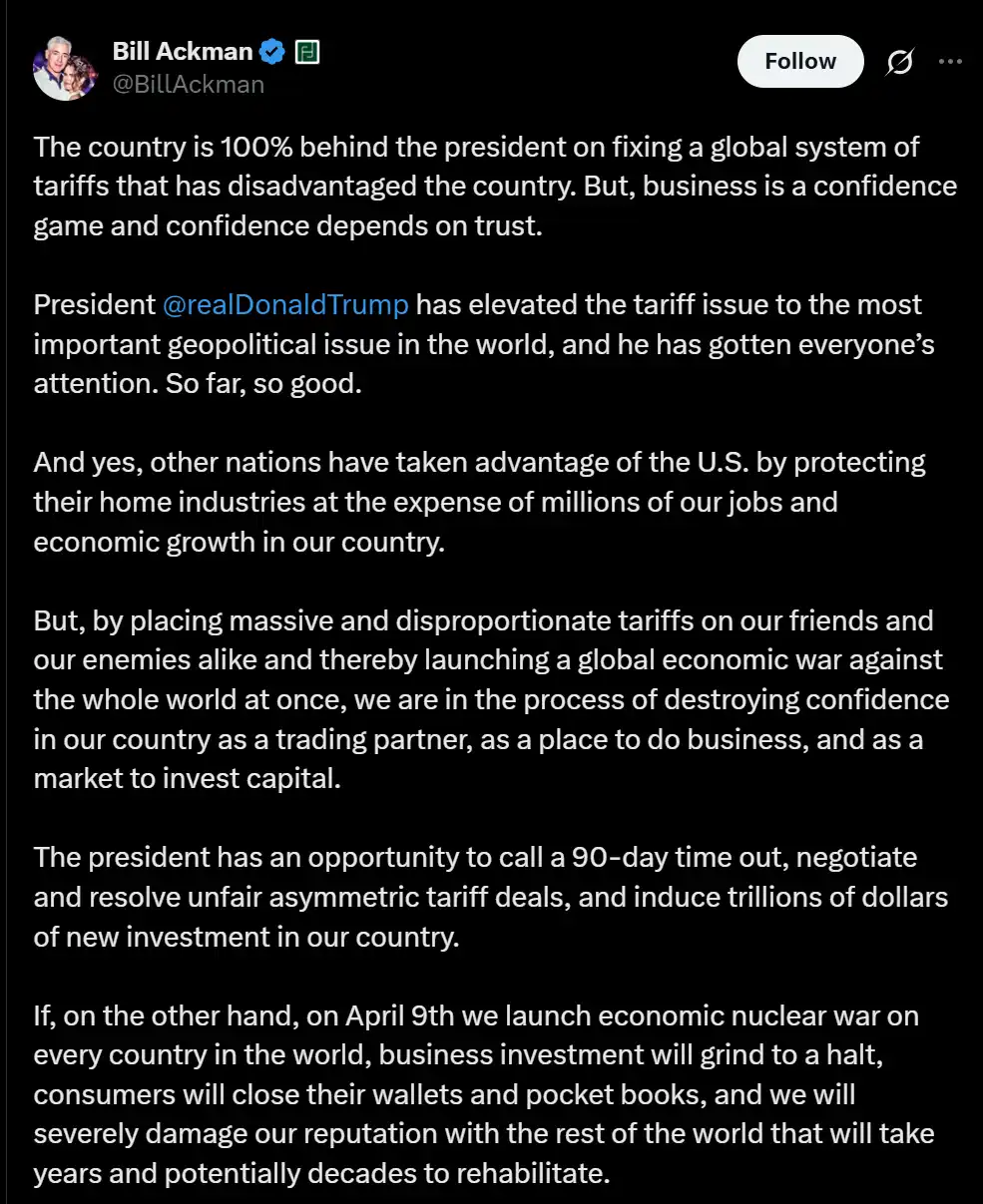
Faced with the Trump administration's escalating tariff policy, Ackman is not the only one sounding the alarm. Many Wall Street heavyweights have openly opposed the expansionary tariff policy, even those who once supported him or hoped for deregulation and economic growth under his administration.
Former Goldman Sachs CEO Lloyd Blankfein also questioned, "Why not give them a chance?" and suggested that Trump should negotiate with other countries on a "reciprocal" tariff rate.
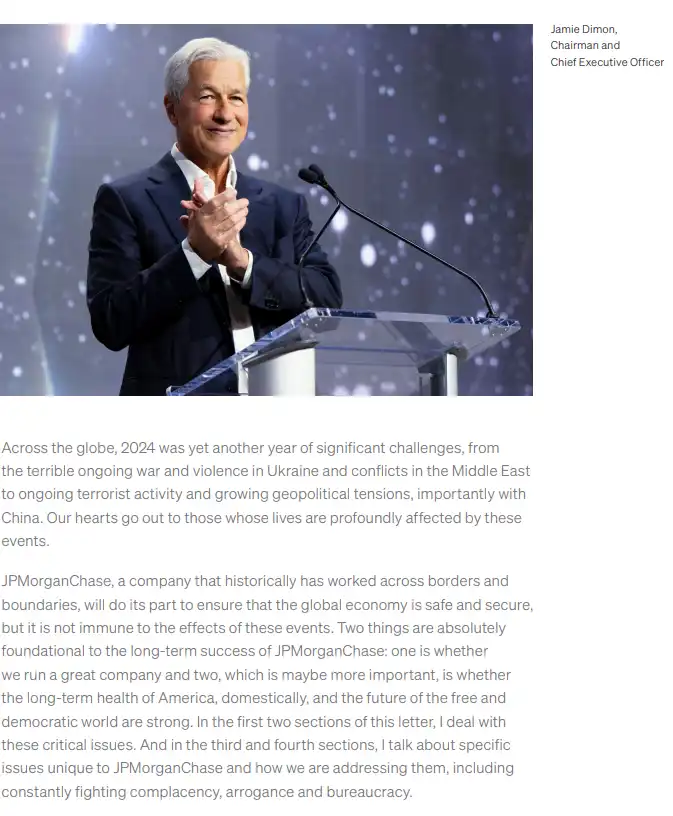
Other voices included Boaz Weinstein, CEO and President of Gerber Kawasaki Ross Gerber, and JPMorgan Chase CEO Jamie Dimon.
Boaz Weinstein predicted that "the avalanche is just beginning." Dimon bluntly said, "The sooner this issue is resolved, the better, as some of the negative impacts will accumulate over time and be difficult to reverse," warning that a catastrophic split in America's long-standing economic alliances could occur. Gerber called President Donald Trump's tariff policy "destructive," saying it could lead to an economic recession.
It is clear that even those accustomed to market volatility, and even financial titans who once supported Trump, are now beginning to worry that this tariff war could trigger uncontrollable chain reactions.
More and more criticism has been directed at Trump for not giving any indication that he is ready to back down from the punitive trade reform set to begin on April 9. The market can tolerate uncertainty but not strongman "policy speculation." This collective outcry from Wall Street indicates that capital is unwilling to foot the bill for political gambling.
Oaktree Capital's Co-Chairman Howard Marks, in an interview with Bloomberg, noted that the tariff policy has altered the established global trade and economic pattern, making the market environment more complex. Investors need to consider a range of unknown variables, such as the inflation that tariffs may trigger, supply chain disruptions, retaliatory measures from trading partners, and the potential impact of these factors on economic growth and asset prices.
Marks's warning actually reveals the anxiety of the entire professional investment community. When policy dominance overrides market rules, the traditional analytical framework is failing, and even the most seasoned fund managers must relearn how to place bets in a global economic game.
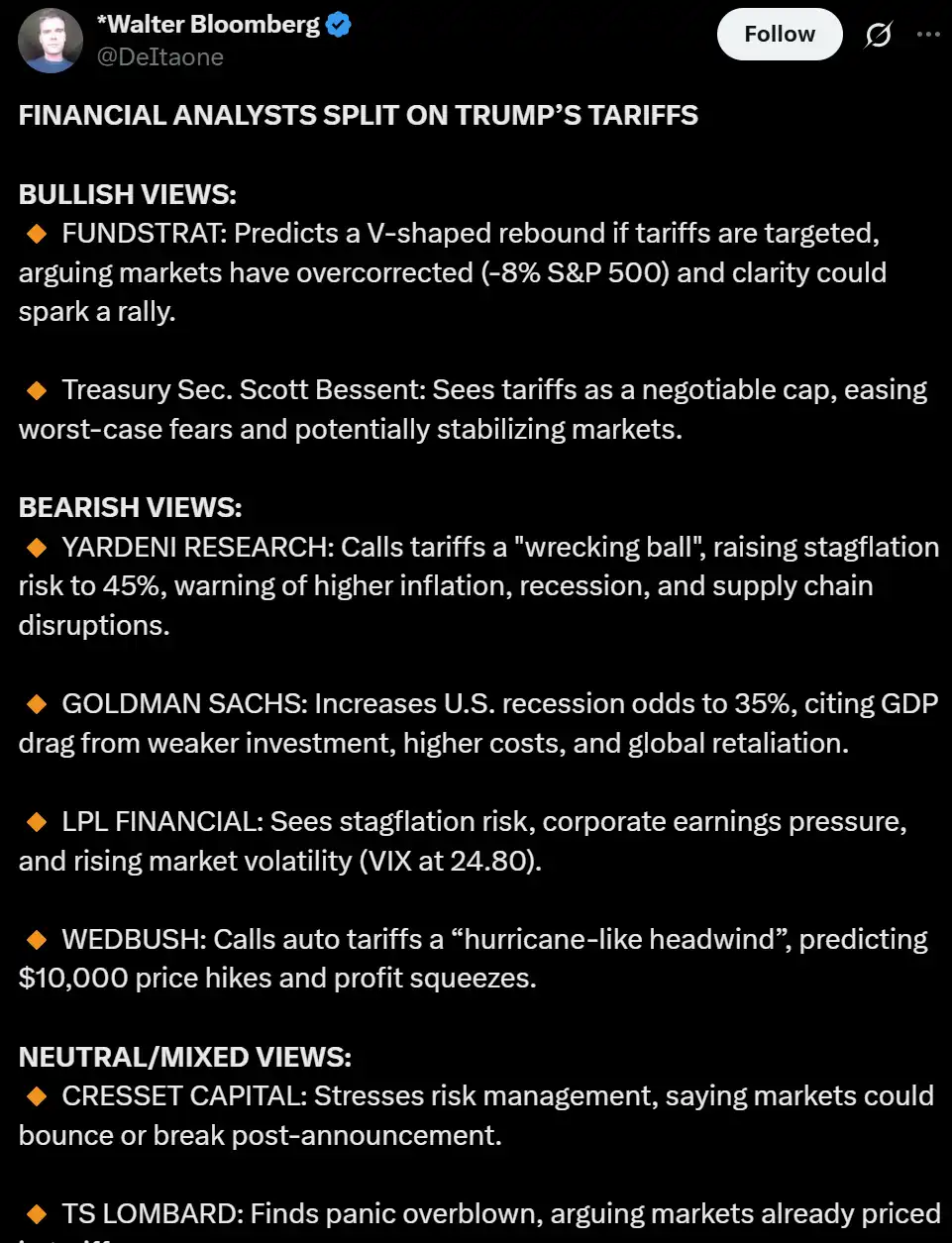
As of April 3, 2025, Wall Street's stance on Trump's tariff policy remains divided. The bulls camp, such as Fundstrat and Treasury Secretary Scott Besent, believe that the previous market adjustment was oversold and that once the policy direction becomes clear, it may trigger a "V-shaped rebound." The bears warn of escalating risks, with Yardeni Research likening tariffs to a "wrecking ball," Goldman Sachs raising the U.S. recession probability to 35%, and LPL and Wedbush expressing concerns about stagflation shadows, corporate profit pressures, and the automotive industry facing severe damage.
Meanwhile, moderates emphasize more on risk management, pointing out that some negative factors have already been priced in by the market, and the future trend largely depends on the intensity of tariff implementation and the actual resilience of the manufacturing sector. However, with the market experiencing severe turbulence and rising panic, voices that were originally in a wait-and-see attitude are also shifting, significantly questioning Trump's tariff policy.
Despite Ken Fisher's ruthless criticism of Trump's tariff plan launched in early April as "stupid, wrong, and extremely arrogant," he still maintains his usual optimism. He believes that "fear is often more frightening than reality" and that this storm may only be a market correction similar to 1998, ultimately potentially yielding up to a 26% annualized return.
Steve Eisman, known for his role in shorting the subprime mortgage crisis and the prototype of "The Big Short," warns that the market has not yet truly reflected the worst-case scenario of Trump's tariff policy and that it is not the time to be a "hero." He bluntly states that Wall Street is overly reliant on the old paradigm of "beneficial free trade" and is inevitably at a loss in the face of a president who breaks with tradition.
He admitted that he also suffered heavy losses from going long, pointing out that the market is filled with the "grievances of the losers." Eiseman also emphasized that current policies are attempting to address the overlooked groups under free trade, and Wall Street should not be surprised by this, as Trump "has long said he would do so, but no one took it seriously."
Amidst the clamor, U.S. Treasury Secretary Scott Bessent emphasized that tariffs are essentially a "maximized leverage" negotiation chip, rather than a long-term economic barrier. He asked, "If tariffs are really so bad, why are our trading partners also using them? If they will only harm American consumers, why are they so nervous?" In his view, this is a counterattack against China's "low-cost, forced labor, and subsidy" system.
However, in reality, Bessent does not seem to have played a key role in the decision-making process and appears more like a "spokesperson" within the government used to appease the market. The dramatic fluctuations caused by the tariffs have also alerted the White House internally.
This tariff storm has exposed the impact of policy uncertainty on market confidence, leading to a rare "collective venting" on Wall Street. Regardless of their position, the majority of voices are questioning or even criticizing the radical and hasty nature of the policy. Behind the disagreements lies a general dissatisfaction with the logic of the policy and the pace of its implementation, and perhaps what really needs to be discussed is how confidence can be rebuilt amidst this chaos?
You may also like

How xBubble Breaks the Deadlock in VC's Heavy Investment in the OPC Economy

Dragonfly partner Haseeb: The fastest-growing companies in the future may all be stuck at 149 people

Morning Report | Former Ethereum Foundation researcher establishes Ethlabs; EU Parliament Economic Committee passes digital euro regulatory proposal

Interview with NDV Founder Jason Huang: Popping the AI Bubble and the Myth of Microstrategy, Seeking the Ultimate Ace in the Crypto Market

Morning Report | The South Korean Financial Services Commission plans to expand the regulatory sandbox to include virtual assets; the parent company of the New York Stock Exchange, ICE, has reached a partnership with OKX to jointly establish a cryptocu...

Exclusive Interview with Strategy CEO: Putting Aside the Sale of 32 BTC, the 60 Trillion AI Intelligence is the Ultimate Fate of Bitcoin

TRON revitalizes the image of the bull, creating a more approachable brand character
Will the STRC issuance price discussed with ChatGPT really fall into a death spiral?

The foundation retreats, Ethlabs steps forward: Ethereum welcomes its largest restructuring in history

NYSE Parent ICE and OKX Launch Joint Venture: What It Means for Tokenized Stocks
ICE and OKX have announced a joint venture focused on tokenized stocks, but stock futures are already live across crypto markets. Here's what the partnership means, how stock futures work, and why traders are paying attention.

How to Trade Apple and Nvidia on a Crypto Exchange in 2026 (Without Buying Shares)
Morning Report | Secret Network loses $4.67 million due to cross-chain vulnerability; Michael Saylor releases Bitcoin Tracker information again, may disclose increased holdings data next week
Kalshi's biggest competitor is not Polymarket

The second half of the computing power battle: Intel CEO Pat Gelsinger reveals how AI is reshaping the global semiconductor supply chain
B.AI partners with MiniMax to launch a limited-time free experience of M3, enabling zero-threshold implementation of Agentic productivity through full-stack infrastructure

A company that was on the verge of bankruptcy has just surpassed Bitcoin in market value

The two giants are racing in "credit": loan balances of 9.9 billion vs 14.6 billion USD, Brazil has become the main battlefield
Rented Belief: How Much of the Bitcoin ETF Fund Flow is Real Money
How xBubble Breaks the Deadlock in VC's Heavy Investment in the OPC Economy
Dragonfly partner Haseeb: The fastest-growing companies in the future may all be stuck at 149 people
Morning Report | Former Ethereum Foundation researcher establishes Ethlabs; EU Parliament Economic Committee passes digital euro regulatory proposal
Interview with NDV Founder Jason Huang: Popping the AI Bubble and the Myth of Microstrategy, Seeking the Ultimate Ace in the Crypto Market
Morning Report | The South Korean Financial Services Commission plans to expand the regulatory sandbox to include virtual assets; the parent company of the New York Stock Exchange, ICE, has reached a partnership with OKX to jointly establish a cryptocu...
Exclusive Interview with Strategy CEO: Putting Aside the Sale of 32 BTC, the 60 Trillion AI Intelligence is the Ultimate Fate of Bitcoin

Popular coins
Latest Crypto News


