
「Bodyguard Coin」 Faces Another Sell-off: Trump Fans Dump 50% of Tokens, Market Cap Plunges

Original Title: "‘Bodyguard Coin’ Scam? Trump Mega-Fan Ryan Fournier Caught in MEME Token Fraud Storm"
Original Author: Zen, PANews
In the American conservative political circle, Ryan Fournier rose to fame as a student organization leader and Trump supporter, but in the cryptocurrency world, as a "crypto newbie," he has become the focal point of a series of controversial events.
From the recent rapid collapse of the "TIKTOK" memecoin to allegedly leveraging Trump's name to hype the "Restore The Republic" (RTR) token, Fournier's presence has repeatedly emerged at the center of controversies. Perhaps due to a translation issue, the Chinese community mistakenly believed he was Trump's bodyguard and referred to this meme coin as the "Bodyguard Coin."
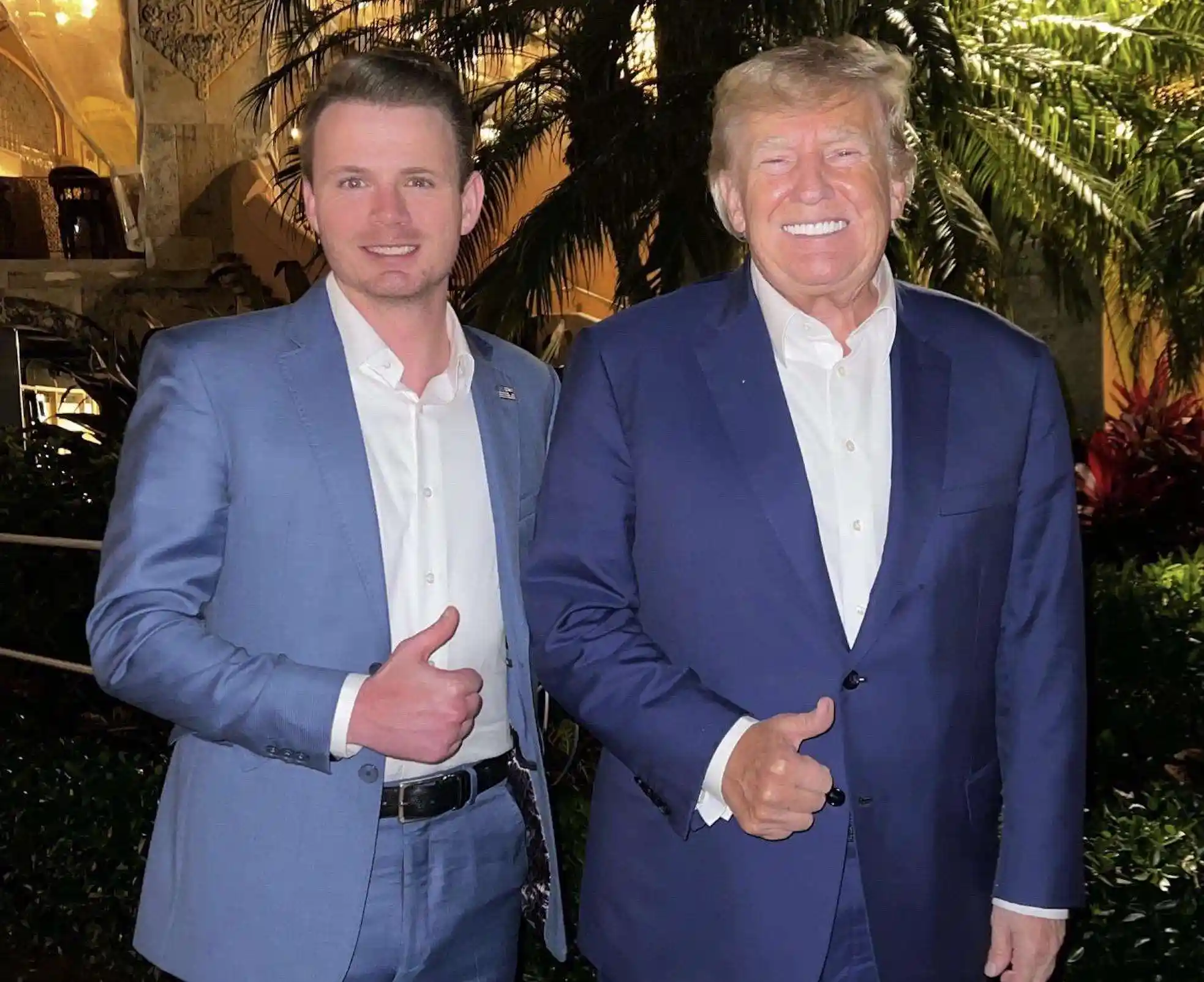
Who is Ryan Fournier?
Ryan Fournier is an American conservative activist, political commentator, co-founder, and national chairman of Students for Trump. As a star figure in MAGA, he is known on social media for his image as a "vanguard" supporter of Trump. For example, Fournier once led a boycott of Walmart in 2018 because the company was selling T-shirts with "Impeach 45" printed on them.
In 2015, while studying at Campbell University in North Carolina, Fournier co-founded Students for Trump with John Lambert, an organization aimed at mobilizing students to support Donald Trump's presidential campaign. As the national chairman of this organization, Ryan Fournier actively participated in related activities and quickly became a youth representative of the MAGA camp.

However, in 2021, John Lambert was sentenced to 13 months in federal prison by a federal judge for operating a fake law firm. Although Ryan Fournier was suspected of assisting John Lambert in establishing the fake law firm in 2016, according to a document submitted by federal prosecutors, he was not indicted because he had been assisting federal law enforcement since around April 2018. However, in November 2023, Fournier was arrested in Johnston County, North Carolina, on suspicion of domestic violence for grabbing his girlfriend's right arm and hitting her with a handgun.
Fournier: Selling 50% of Memecoin, But I Did Not Commit Fraud
On Sunday of last week, after TikTok went back online in the United States, Ryan Fournier announced in X Space that he had teamed up with a memecoin trader named Asta to launch a TikTok-themed memecoin called "TIKTOK." Asta claimed to be responsible for creating the token and had sent 50% of the supply to Fournier, retaining only 1% for themselves.
Perhaps influenced by the massive surge of the TRUMP and MELANIA tokens, the value of TikTok quickly skyrocketed after its launch, reaching a peak market cap of nearly $90 million. During this time, Fournier had posted a screenshot on X platform showing his holdings amounting to $19 million. Simultaneously, Asta excitedly wrote on X, "I sent 50% of TIKTOK to Fournier, which is basically my entire supply. I just wanted to start a cool movement, and now the token's market value has reached $60 million. It would be really cool if I hold the token."
Following Asta's post, Fournier immediately sold all of his TikTok tokens. Asta expressed their disappointment in another post less than 10 minutes after the previous one. According to Fournier's confirmation of a wallet address starting with 9H, he exchanged 505 million TIKTOK tokens for approximately $700,000 worth of SOL at 20:28 UTC on Sunday. This action caused the TIKTOK token price to plummet to zero.
The incident sparked strong community outrage, with many condemning Fournier's actions. Fournier defended himself by stating that Asta had suddenly sold off TIKTOK first, and he followed suit. "So I don't know what happened... I think the guy is a scammer, and I think he just scammed me, and I followed him."
Fournier repeatedly insisted that he was a newcomer to the cryptocurrency space and was confused by some terms. "You're talking to a newcomer in the cryptocurrency space. I don't even know if I can sell anything." Fournier denied profiting from the sale, claiming to be "almost at a loss" after buying and then selling the token. He also posted on X that he would stay away from cryptocurrency in the future until he has a better understanding of whom to trust, as he looks forward to working for the new administration of President Trump. However, in X Space, he boasted of having connections to Trump's cryptocurrency advisor.
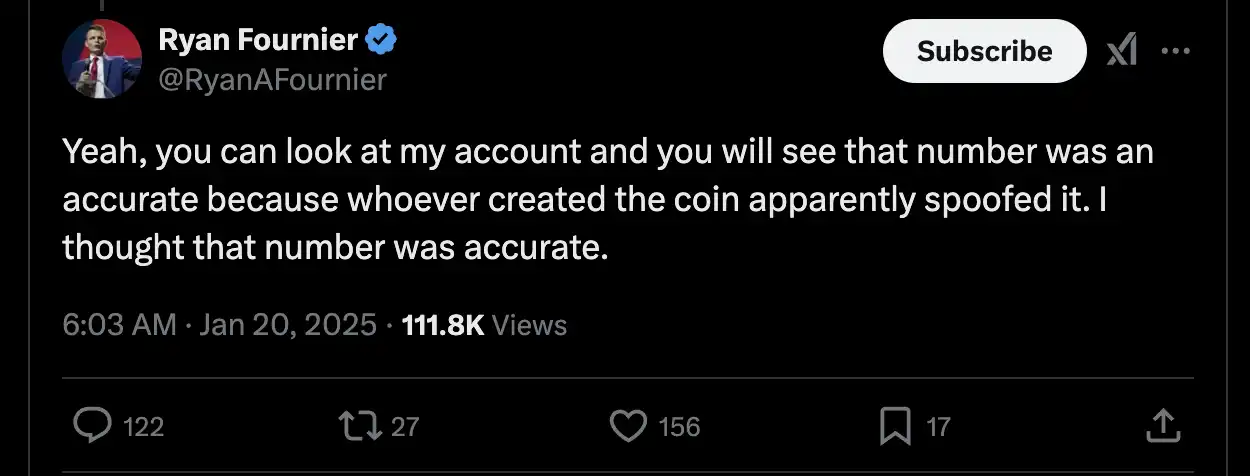
When someone presented a screenshot of Fournier boasting about his holdings, Fournier responded, "Yes, you can look at my account, that number is indeed accurate. Because the person who created the token obviously manipulated the price. I also thought that number was real." This response was criticized and mocked by many traders, who said Fournier was truly an insatiable clown. "Fournier doesn't understand the slippage mechanism of cryptocurrency trading. He thought that he would receive the total amount displayed on the interface after selling, but in reality, he only received a small portion of the funds."
"He said he would never sell and that he is reaching out to TikTok. This guy really stole so much money." Another key figure in this incident, Asta, also criticized Fournier in his response. Although there is no evidence that Asta made a substantial profit in this incident, as the 'instigator,' the community's attitude towards him has been mostly critical, with many people even saying, "You should also go to jail."
In fact, as a newcomer to the crypto world, Fournier, although relatively new to cryptocurrency, has already stirred controversy on more than one occasion.
RTR Token Event: Controversy Sparked by Using Trump's Name
About half a year ago, when the Trump family launched their own DeFi project to enter the crypto sphere, Fournier had already caused a controversy.
"We are about to shock the cryptocurrency world with a major event. Decentralized finance is the future; do not lag behind." In August 2024, Trump's two sons, Eric Trump and Donald Trump Jr., tweeted, expressing not only their love and support for cryptocurrency but also hinting at a major announcement for the industry. Thus, the "World Liberty Financial" project was officially put on the agenda, marking Trump's involvement in cryptocurrency beyond just verbal support.
Just as industry confidence was being boosted, a memecoin project called Restore The Republic (RTR) related to Trump himself suddenly appeared on the X platform, with rumors circulating, and the source of this "internal news" was Ryan Fournier. Another well-known influencer, @SizeChad, released a video stating, "If they don't buy RTR token, their T level will be very low" (T level is a metaphor for testosterone levels, symbolizing masculinity). This promotion slogan of "real men should buy RTR token" also aligns with Trump's emphasis on personal "strength" and "vitality" to showcase male charisma.
After this news spread, RTR began to experience a classic pump and dump scenario, with its token price sharply rising and then plummeting. It was suspected that an insider used four wallets to trade Restore The Republic (RTR) and made a profit of $3.8 million. However, the team behind the Restore The Republic X account stated on X Sunday that Fournier was not involved in the project and had never received any RTR tokens from that team. They stated in their announcement: "Ryan is not and has never been a part of the team."
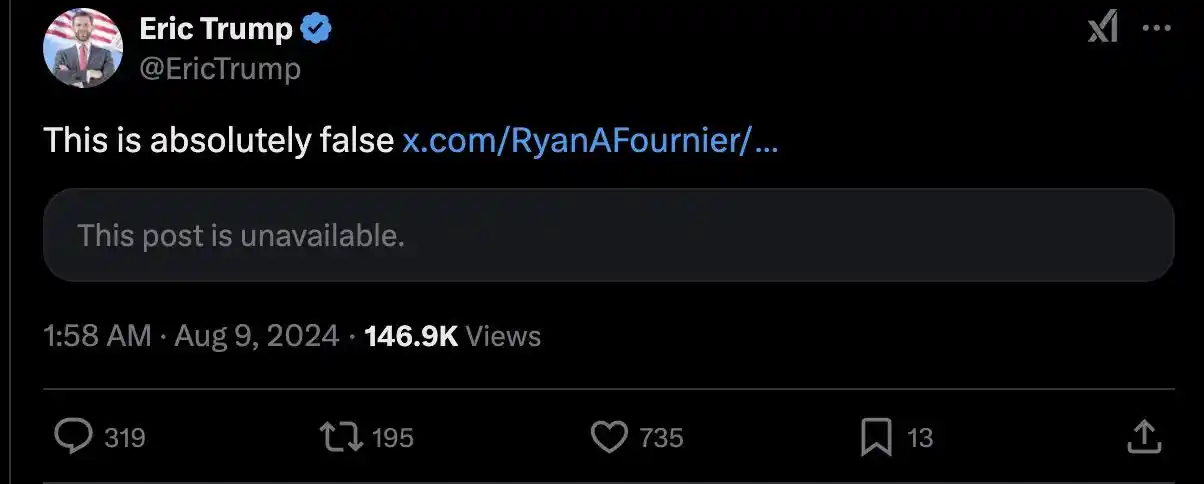
Upon discovering this rumor, Eric Trump swiftly denied any connection between the token and their family on X and condemned Fournier. Once the rumor was clarified, RTR's token price immediately crashed by 95%. Fournier and @SizeChad also deleted their previous tweets promoting the token.
Furthermore, Donald Trump Jr. also came forward to deny the long-standing rumors about the Trump family launching a meme coin. He hinted that his family is planning a new blockchain project and mentioned that this project is "much larger in scale" than simply launching another meme coin.
However, the recent eventful weekend just showed everyone, including Little Trump, the answer: in terms of scale, simply launching another meme coin would be much larger for the Trump family.
You may also like

$75 billion in foreign capital has fled, and South Korean retail investors have absorbed it all using leverage

Bitcoin Trading Guide 2026: Strategies for Experienced Traders

What Is XAUT and PAXG? Why Tokenized Gold Is Booming in 2026

Cryptocurrency CEXs are flocking to sell US stocks, and traditional brokerages are facing an "uninvited guest."

Will the SpaceX IPO Hurt Bitcoin? Here's What Traders Are Watching
Foreign selling in the South Korean stock market accelerates, with cumulative net sales reportedly reaching $75 billion this year
On June 9, The Kobeissi Letter, citing Goldman Sachs data, reported that global investors are selling South Korean stocks at an unusually rapid pace. In the latest trading session, foreign investors sold about $801 million worth of Kospi constituent stocks again; total foreign outflows last week reached about $10 billion, and the market has been in net foreign selling on nearly every trading day over the past month. According to the data cited in the report, foreign investors have sold about $75 billion worth of South Korean stocks so far this year. Meanwhile, South Korean retail and institutional investors together recorded roughly $69 billion in net buying over the same period, suggesting that the market’s main buying support has come from domestic capital rather than returning overseas funds. The information currently disclosed still mainly comes from The Kobeissi Letter’s retelling and Goldman Sachs data summaries, while public details on the statistical period and the specific definition of “selling” remain relatively limited.

Fortune Warns of Strategy’s Financing Structure Risks as Bitcoin Premium Narrows
Fortune warned that Strategy’s Bitcoin treasury model faces growing financing risks as MSTR’s net asset premium narrows and preferred stock dividend pressure increases.

Ferrari Challenge Le Mans: Carl Moon to Dominate in WEEX Livery

Sahara AI Responds to SAHARA’s Sharp Drop: No Contract or Product Security Issues Found, Internal Investigation Underway
Sahara AI responded to SAHARA’s 60% price drop, saying no token contract or product security issues have been found and an internal investigation is underway.

WEEX Deposit/Withdrawal Dynamic Island: Your Asset Status, Always in Sight

Scaling Crypto Derivatives: The Digital Asset Infrastructure Behind High-Volume Trading
In the fast-moving digital asset ecosystem, derivatives platforms face an extreme architectural test. High-leverage futures markets demand more than just standard security—they require absolute operational precision, zero-latency matching engines, and ironclad structural scalability, all while navigating intense market volatility.
As global platforms scale to meet these demands, the industry is shifting away from rigid, monolithic setups toward a more agile, "decoupled" infrastructure philosophy.
The Blueprint for High-Volume Copy TradingFor elite global exchanges like WEEX (founded in 2018), this architectural choice becomes critical when scaling high-volume retail features like social copy trading. When thousands of users automatically mirror the real-time strategies of elite traders simultaneously, it triggers sudden, monumental spikes in concurrent transactional volume.
To prevent execution latency or settlement bottlenecks during these peak volatility events, a platform's primary engine must remain entirely dedicated to risk management, copy-trade synchronization, and order matching.
The Architectural Rule: New-generation platforms must separate front-end user execution engines from heavy backend infrastructural overhead to eliminate operational friction.
By separating these layers, platforms can maintain complete sovereignty over their trading environments and user experiences while strategically aligning with institutional-grade infrastructure ecosystems. This strategic framework allows modern exchanges to leverage advanced Digital Asset Custody infrastructure such as Cobo’s behind the scenes, ensuring that backend wallet management scales elastically alongside trading spikes.
Capitalizing on Market Momentum and 400× LeverageIn a derivatives arena where platforms offer up to 400× leverage on perpetual contracts, capital efficiency and market agility are core business metrics. To capture market momentum, an exchange needs the ability to rapidly expand its asset offerings, supporting everything from legacy crypto assets to sudden, trending altcoins across a massive library of trading pairs.
Adopting a flexible, scalable Wallet-as-a-Service (WaaS) solution such as Cobo’s could completely rewrite the development timeline for high-growth exchanges. Instead of spending months of engineering capital building out custom backend wallet architectures for every new blockchain network, platforms can deploy localized infrastructure in days.
This agility allows platforms to instantly scale their listings to over a thousand trading pairs without compromising security or delaying time-to-market. It mirrors the exact operational advantages seen during high-velocity market events, similar to how advanced wallet infrastructure empowers platforms during sudden asset surges; allowing exchanges to pass that speed and liquidity directly to their global user base.
A Mature Foundation for GrowthThe synergy between trusted infrastructure ecosystems and global trading platforms represents the natural evolution of a maturing crypto market. As WEEX continues to scale its global spot and derivatives offerings for over 6 million users, adopting robust backend paradigms proves that platforms no longer have to compromise between cutting-edge trading velocity and uncompromised structural security.

Morning Report | BitMine increased its holdings by 126,971 ETH last week; trader Eugene announced his exit from the crypto market

Wang Chuan: How can one not feel anxious after the neighbor Old Wang made thirty times profit by investing in storage stocks? (Seven) - A quarter-century cycle

Get Paid to Onboard? Try WEEX’s New Homepage with Rewards for Registration, Deposit & Trade

WEEX Custom Layout: Build Your Perfect Trading Workspace in Seconds

See “Buy Walls” & “Sell Walls” Instantly: WEEX Launches the Depth Chart for Smarter Trades

What Is Quick Trade on WEEX? 2 Ways WEEX Ends Chart-Panel Jumping
Morning News | Five major virtual asset platforms in South Korea have experienced 57 incidents of hacking and system failures in six years; Grayscale submits registration application for Canton ETF
$75 billion in foreign capital has fled, and South Korean retail investors have absorbed it all using leverage
Bitcoin Trading Guide 2026: Strategies for Experienced Traders
What Is XAUT and PAXG? Why Tokenized Gold Is Booming in 2026
Cryptocurrency CEXs are flocking to sell US stocks, and traditional brokerages are facing an "uninvited guest."
Will the SpaceX IPO Hurt Bitcoin? Here's What Traders Are Watching
Foreign selling in the South Korean stock market accelerates, with cumulative net sales reportedly reaching $75 billion this year
On June 9, The Kobeissi Letter, citing Goldman Sachs data, reported that global investors are selling South Korean stocks at an unusually rapid pace. In the latest trading session, foreign investors sold about $801 million worth of Kospi constituent stocks again; total foreign outflows last week reached about $10 billion, and the market has been in net foreign selling on nearly every trading day over the past month. According to the data cited in the report, foreign investors have sold about $75 billion worth of South Korean stocks so far this year. Meanwhile, South Korean retail and institutional investors together recorded roughly $69 billion in net buying over the same period, suggesting that the market’s main buying support has come from domestic capital rather than returning overseas funds. The information currently disclosed still mainly comes from The Kobeissi Letter’s retelling and Goldman Sachs data summaries, while public details on the statistical period and the specific definition of “selling” remain relatively limited.


