
Flagship Project Community Plans "Palace Intrigue," Community Outrage Sweeps Over Ethereum Foundation

Original Title: "Top Projects Jointly Pressure Ethereum Foundation, No Response"
Original Author: Azuma, Odaily Planet Daily
The Ethereum Foundation (EF) has been in a world of suffering for a long time.
As disappointment with ETH's weak performance in this cycle gradually accumulated within the community and finally erupted, the calls for reforming the EF grew louder.
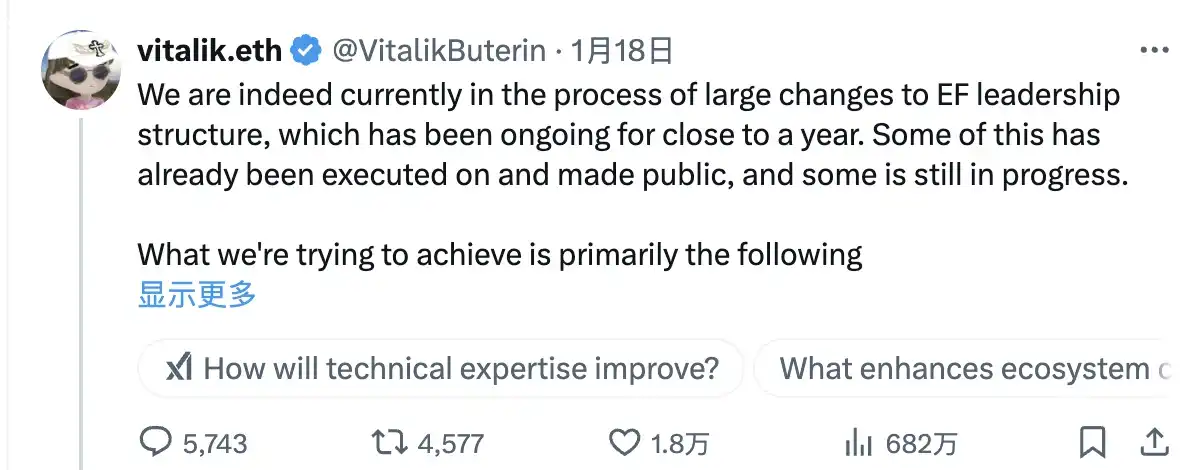
Over the past few days, the entire Ethereum community has been discussing EF's leadership structure, personnel composition, operational mode, and financial plans. The current EF Executive Director, Aya Miyaguchi, has been criticized by the community, and even Vitalik himself, under heavy pressure, had to publicly declare a "large-scale restructuring of the EF leadership."
By the time Monday came, the discussion deepened further. Founders and executives of several top Ethereum ecosystem projects one after another made statements, denouncing various wrongdoings of the EF. The intensity of their remarks shows that major project parties have also long been dissatisfied with Ethereum's performance.
Below is a collection of various opinions compiled by Odaily Planet Daily.
Synthetix, Infinex Founder: EF Should Require L2 to Use Revenue for ETH Buyback
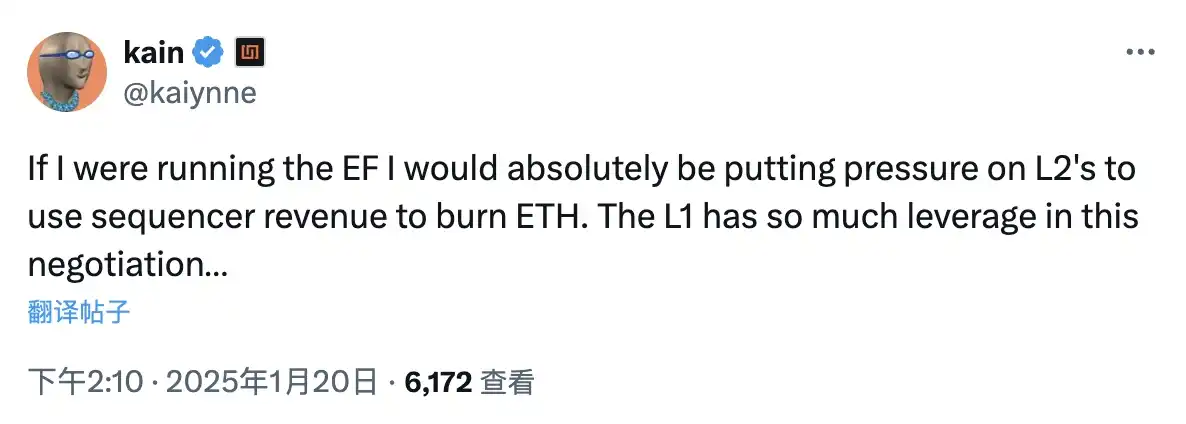
Synthetix, Infinex founder Kain Warwick was the first to challenge.
On Monday afternoon, Kain posted on X, saying: "If I were to operate the EF, I would definitely put pressure on Layer 2, requiring them to use sequencer revenue to burn ETH. Ethereum has a significant advantage in this negotiation...".
Curve Founder: EF Should Immediately Abandon L2 Strategy
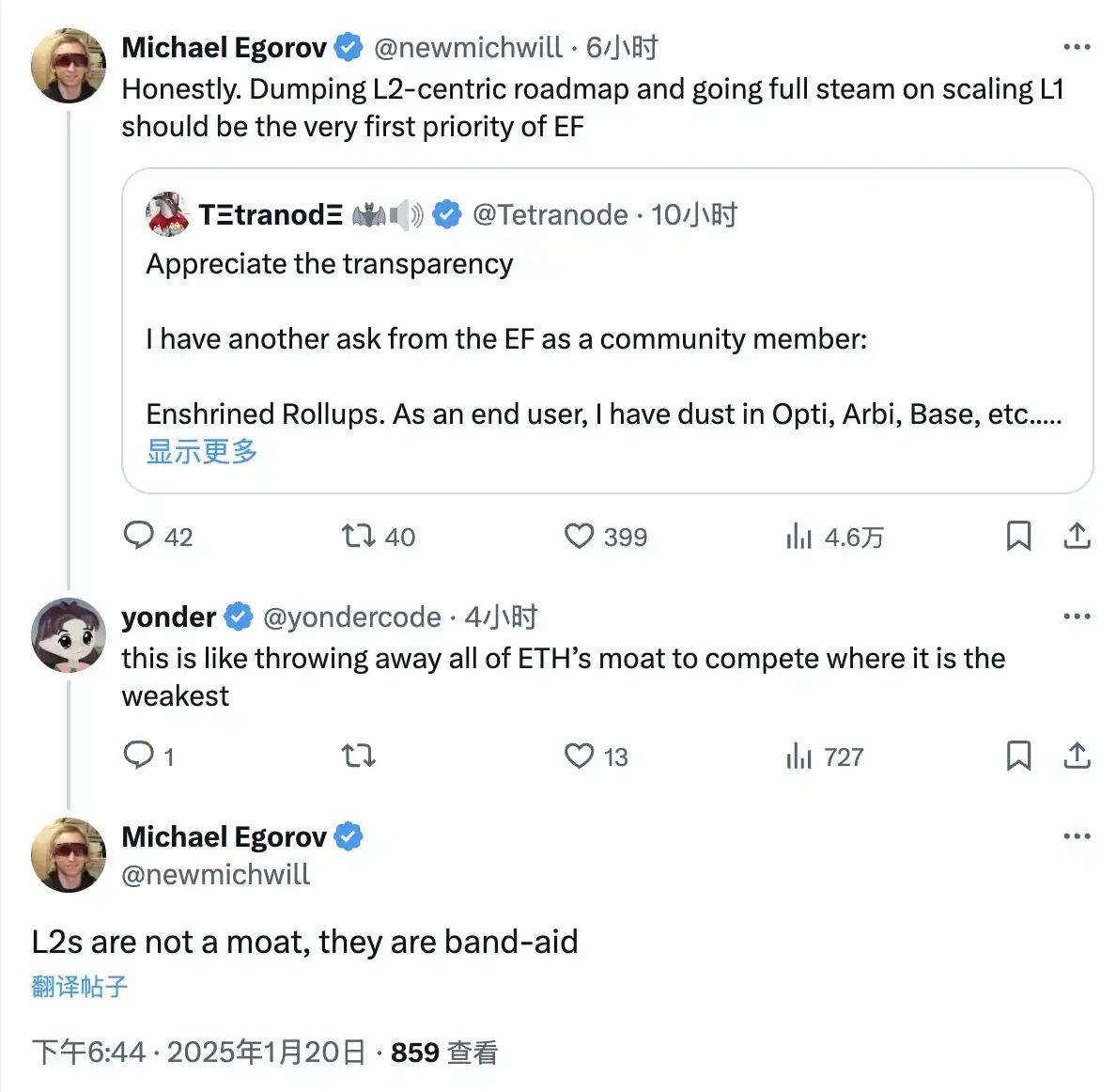
Following Kain, Curve Finance founder Michael Egorov also came out attacking Layer 2, but his wording was more aggressive.
On Monday afternoon, Egorov posted on X, stating that EF's top priority should be to abandon the L2-centric roadmap and instead focus on expanding Layer 1.
In a discussion with the community later, Egorov also bluntly stated, "Layer 2 is not a moat, but a Band-Aid."
Aave Founder: 12 Steps to Rescue EF
Later in the evening, Aave founder Stani Kulechov posted a lengthy article on X stating that he had read the EF Annual Budget Report and believed that the EF needed thorough reform in 12 areas to achieve better sustainability:
1. Immediately reduce the burn rate from $130 million to $30 million;
2. Reduce the number of employees to 80;
3. Carefully review who can stay. Remove senior positions, advisors, any part-time roles, interns, freeloaders, cockroaches, and parasites;
4. Prohibit advisors or any conflicts of interest;
5. Ensure that 80% of employees are technical personnel;
6. Split all technical teams into small 5-person teams, each focusing on specific areas and expertise;
7. The leadership should be a 5-person committee, selected based on performance, with one serving as chairman, responsible to VB;
8. Part of the non-technical team should focus on financial management (handled internally);
9. Diversify finances into various Long-term Sustainable Tokens (LRSTs), as well as fundamentally sound and profitable DeFi and non-DeFi projects built on Ethereum;
10. Diversify staking rewards into stablecoins and invest funds in DeFi;
11. Manage the financials with Aave borrowings and sell periodically when ETH outperforms other assets;
12. Create a sustainable revenue model from transaction or staking fees to fund a reasonable EF budget.
Former Growth Lead at Ethena: EF Should Focus on DeFi
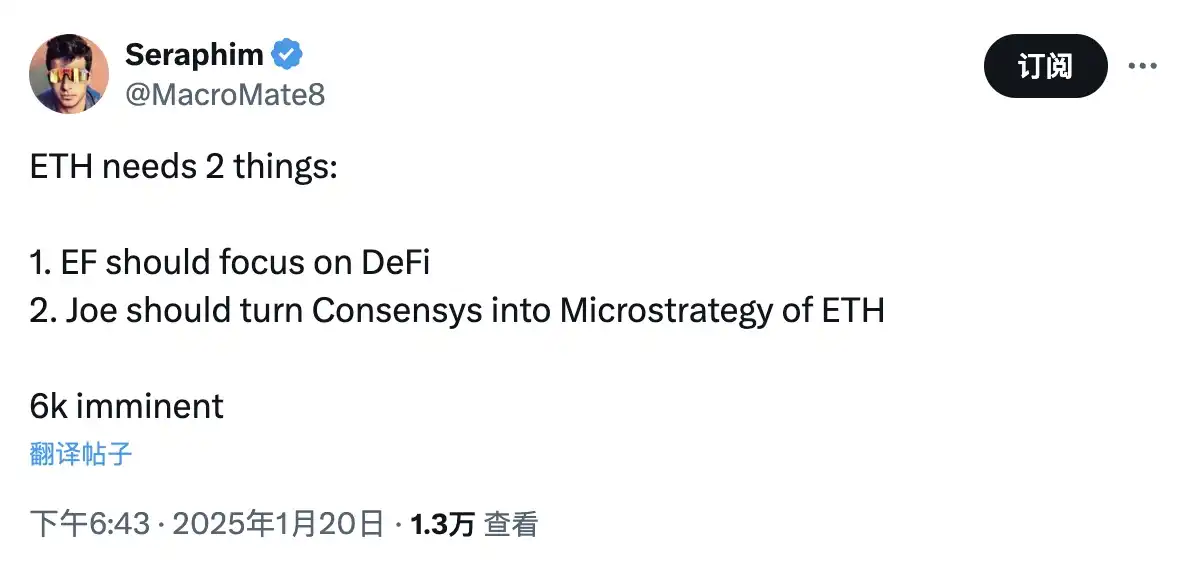
Recently resigned Former Growth Lead at Ethena, also the former Expansion Lead at Lido, Seraphim, also shared his views on EF reform.
Seraphim mentioned that Ethereum needs two paths to self-rescue: first, the EF should focus on DeFi, and second, Consensys, led by Ethereum co-founder Joseph Lubin, should emulate Microstrategy's approach to BTC. As long as these two points can be achieved, ETH will quickly surpass $6000.
Wintermute Founder: Ethereum's Potential Death Spiral Risk
Industry-leading market maker Wintermute, while not exclusive to the Ethereum ecosystem, has directly provided liquidity to many Ethereum ecosystem projects, making its stance equally impactful on Ethereum.
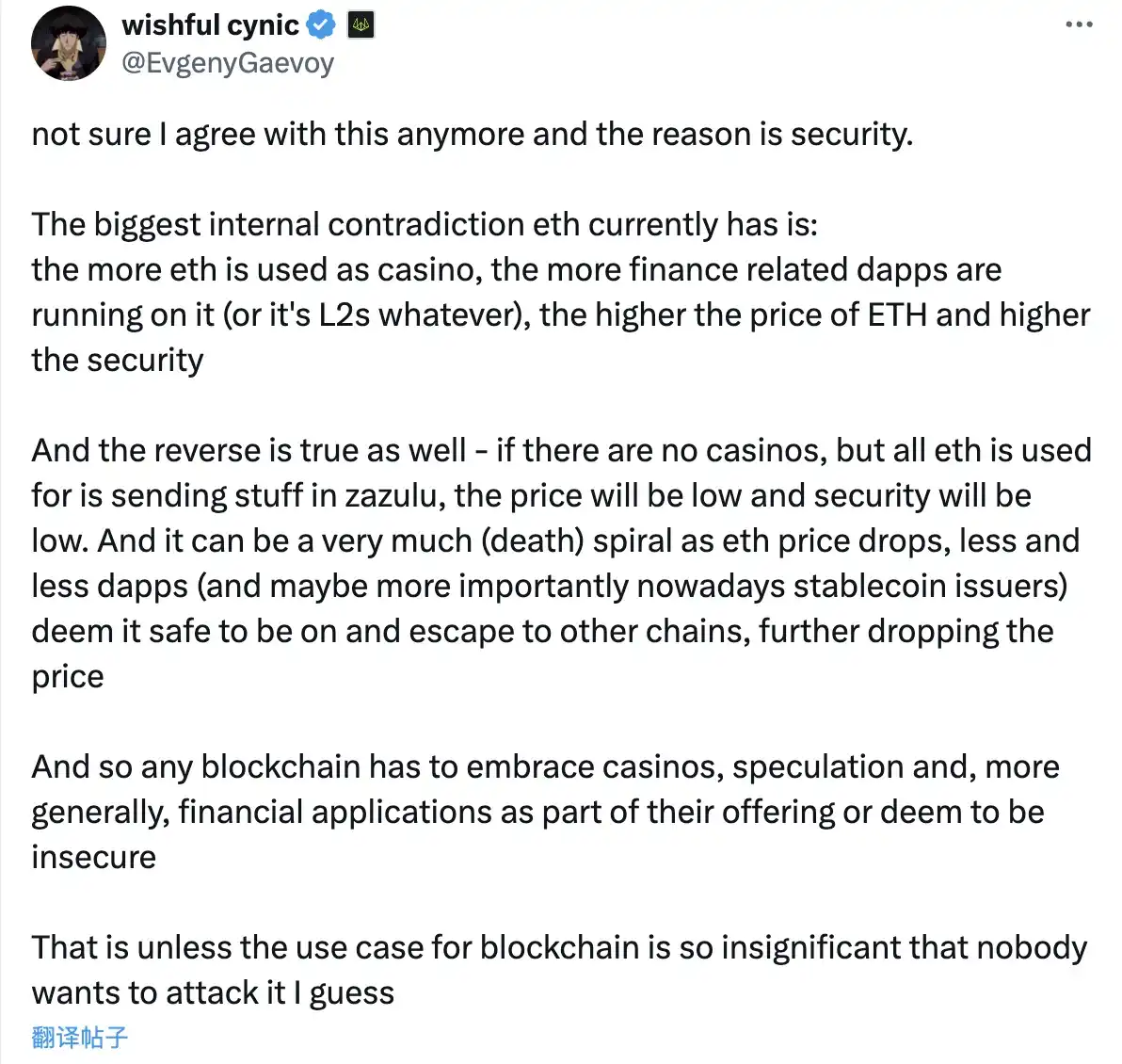
Last night, founder and CEO Evgeny Gaevoy wrote about the potential death spiral risk for Ethereum.
Evgeny stated that Ethereum's biggest internal contradiction currently is: the more ETH is used for "gambling," and the more finance-related dApps run on Ethereum, the higher the price of ETH and the higher the security; conversely, if there is no gambling behavior and ETH is only used for transfers on Zazulu, then the price of ETH would be very low, and the security would also be low. As the price of ETH drops, dApps that still consider Ethereum secure will increasingly move to other chains, further lowering the price of ETH, which could lead to a significant death spiral.
Therefore, any blockchain must consider gambling, speculation, and broader financial applications as part of its product, or else it will be seen as insecure.
Amidst Public Outrage, EF Once Again Chooses to Sell...
During a period of community outcry and unrelenting public anger, the EF has once again made a surprising move.
At around 6:20 PM, the address 0xd77...1f4, known for small-value high-frequency ETH sales, once again sold 100 ETH at an average price of $3364.
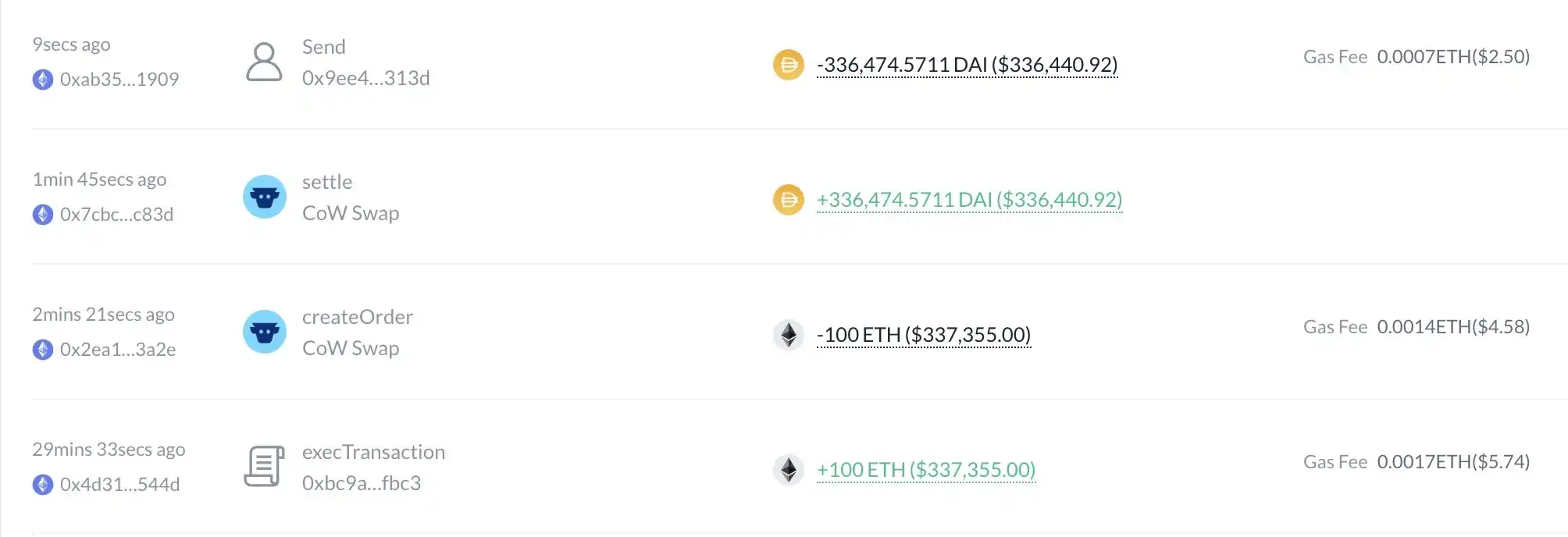
As a long-time ETH holder, I find it hard to understand why the EF would make such a "low-value but highly symbolic" move at such a sensitive time, especially when the community actively suggested that the EF use staking rewards instead of direct selling, and this proposal was also acknowledged by Vitalik as something to explore further.
You read that right; as the top-level organization in the Ethereum ecosystem, the EF hasn't even staked its ETH holdings. Vitalik's explanation for this is firstly concern about regulatory issues, and secondly, the EF's neutrality issue, as if the EF were to stake on its own, it would force them to take a stance on any future contentious hard fork.
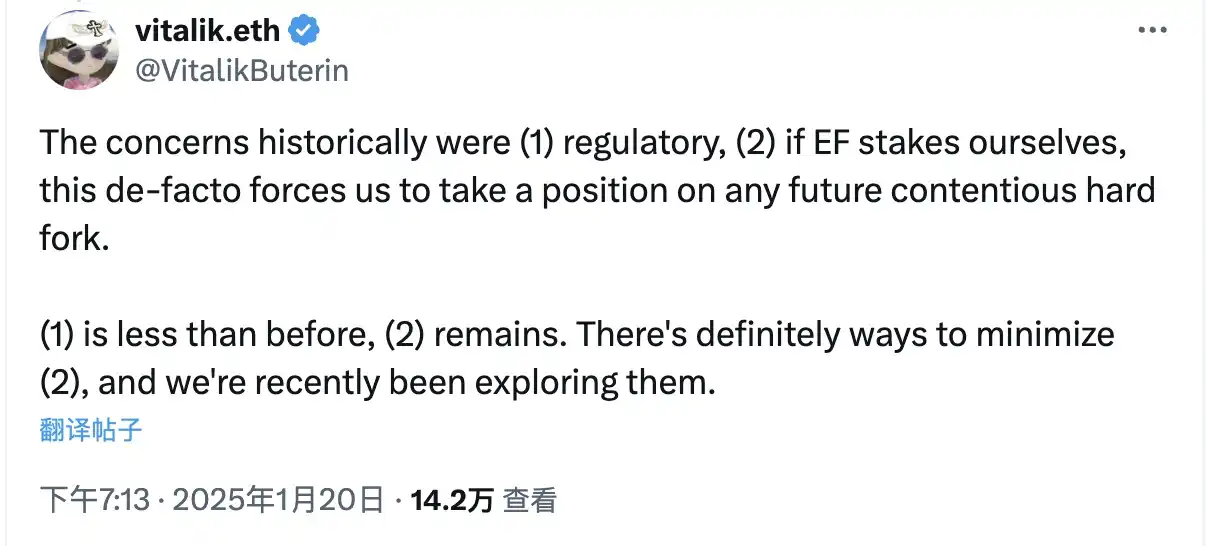
Not much to say about regulatory issues. In fact, with the overall relaxation of the regulatory environment, this has gradually become a non-issue.
As for the second point, does this explanation really hold water? With Solana breathing down their neck, competition has reached a do-or-die stage, yet the EF is still seemingly "avoiding suspicion" for some hypothetical future scenario.
Oh, by the way, the EF seems to be indifferent to competition — today the Ethereum community dug up Aya Miyaguchi's previous statement in an interview: "I am training people to say no to a culture of competition and winning."
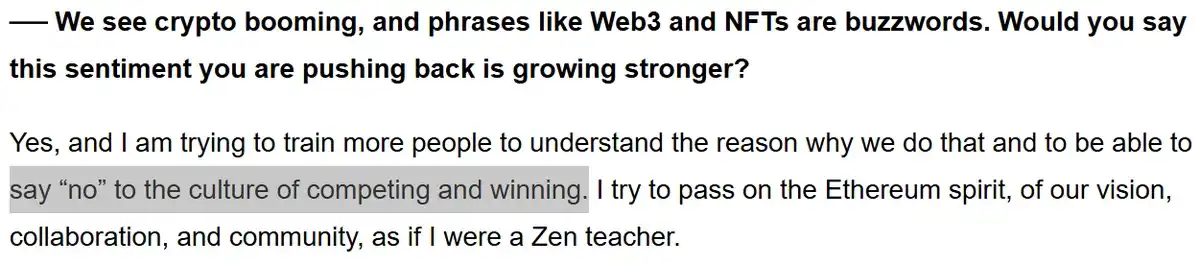
No comment; let's hope the day of real change comes soon.
You may also like

$75 billion in foreign capital has fled, and South Korean retail investors have absorbed it all using leverage

Bitcoin Trading Guide 2026: Strategies for Experienced Traders

What Is XAUT and PAXG? Why Tokenized Gold Is Booming in 2026
Cryptocurrency CEXs are flocking to sell US stocks, and traditional brokerages are facing an "uninvited guest."

Will the SpaceX IPO Hurt Bitcoin? Here's What Traders Are Watching
Foreign selling in the South Korean stock market accelerates, with cumulative net sales reportedly reaching $75 billion this year
On June 9, The Kobeissi Letter, citing Goldman Sachs data, reported that global investors are selling South Korean stocks at an unusually rapid pace. In the latest trading session, foreign investors sold about $801 million worth of Kospi constituent stocks again; total foreign outflows last week reached about $10 billion, and the market has been in net foreign selling on nearly every trading day over the past month. According to the data cited in the report, foreign investors have sold about $75 billion worth of South Korean stocks so far this year. Meanwhile, South Korean retail and institutional investors together recorded roughly $69 billion in net buying over the same period, suggesting that the market’s main buying support has come from domestic capital rather than returning overseas funds. The information currently disclosed still mainly comes from The Kobeissi Letter’s retelling and Goldman Sachs data summaries, while public details on the statistical period and the specific definition of “selling” remain relatively limited.

Fortune Warns of Strategy’s Financing Structure Risks as Bitcoin Premium Narrows
Fortune warned that Strategy’s Bitcoin treasury model faces growing financing risks as MSTR’s net asset premium narrows and preferred stock dividend pressure increases.

Ferrari Challenge Le Mans: Carl Moon to Dominate in WEEX Livery

Sahara AI Responds to SAHARA’s Sharp Drop: No Contract or Product Security Issues Found, Internal Investigation Underway
Sahara AI responded to SAHARA’s 60% price drop, saying no token contract or product security issues have been found and an internal investigation is underway.

WEEX Deposit/Withdrawal Dynamic Island: Your Asset Status, Always in Sight

Scaling Crypto Derivatives: The Digital Asset Infrastructure Behind High-Volume Trading
In the fast-moving digital asset ecosystem, derivatives platforms face an extreme architectural test. High-leverage futures markets demand more than just standard security—they require absolute operational precision, zero-latency matching engines, and ironclad structural scalability, all while navigating intense market volatility.
As global platforms scale to meet these demands, the industry is shifting away from rigid, monolithic setups toward a more agile, "decoupled" infrastructure philosophy.
The Blueprint for High-Volume Copy TradingFor elite global exchanges like WEEX (founded in 2018), this architectural choice becomes critical when scaling high-volume retail features like social copy trading. When thousands of users automatically mirror the real-time strategies of elite traders simultaneously, it triggers sudden, monumental spikes in concurrent transactional volume.
To prevent execution latency or settlement bottlenecks during these peak volatility events, a platform's primary engine must remain entirely dedicated to risk management, copy-trade synchronization, and order matching.
The Architectural Rule: New-generation platforms must separate front-end user execution engines from heavy backend infrastructural overhead to eliminate operational friction.
By separating these layers, platforms can maintain complete sovereignty over their trading environments and user experiences while strategically aligning with institutional-grade infrastructure ecosystems. This strategic framework allows modern exchanges to leverage advanced Digital Asset Custody infrastructure such as Cobo’s behind the scenes, ensuring that backend wallet management scales elastically alongside trading spikes.
Capitalizing on Market Momentum and 400× LeverageIn a derivatives arena where platforms offer up to 400× leverage on perpetual contracts, capital efficiency and market agility are core business metrics. To capture market momentum, an exchange needs the ability to rapidly expand its asset offerings, supporting everything from legacy crypto assets to sudden, trending altcoins across a massive library of trading pairs.
Adopting a flexible, scalable Wallet-as-a-Service (WaaS) solution such as Cobo’s could completely rewrite the development timeline for high-growth exchanges. Instead of spending months of engineering capital building out custom backend wallet architectures for every new blockchain network, platforms can deploy localized infrastructure in days.
This agility allows platforms to instantly scale their listings to over a thousand trading pairs without compromising security or delaying time-to-market. It mirrors the exact operational advantages seen during high-velocity market events, similar to how advanced wallet infrastructure empowers platforms during sudden asset surges; allowing exchanges to pass that speed and liquidity directly to their global user base.
A Mature Foundation for GrowthThe synergy between trusted infrastructure ecosystems and global trading platforms represents the natural evolution of a maturing crypto market. As WEEX continues to scale its global spot and derivatives offerings for over 6 million users, adopting robust backend paradigms proves that platforms no longer have to compromise between cutting-edge trading velocity and uncompromised structural security.

Morning Report | BitMine increased its holdings by 126,971 ETH last week; trader Eugene announced his exit from the crypto market

Wang Chuan: How can one not feel anxious after the neighbor Old Wang made thirty times profit by investing in storage stocks? (Seven) - A quarter-century cycle

Get Paid to Onboard? Try WEEX’s New Homepage with Rewards for Registration, Deposit & Trade

WEEX Custom Layout: Build Your Perfect Trading Workspace in Seconds

See “Buy Walls” & “Sell Walls” Instantly: WEEX Launches the Depth Chart for Smarter Trades

What Is Quick Trade on WEEX? 2 Ways WEEX Ends Chart-Panel Jumping
Morning News | Five major virtual asset platforms in South Korea have experienced 57 incidents of hacking and system failures in six years; Grayscale submits registration application for Canton ETF
$75 billion in foreign capital has fled, and South Korean retail investors have absorbed it all using leverage
Bitcoin Trading Guide 2026: Strategies for Experienced Traders
What Is XAUT and PAXG? Why Tokenized Gold Is Booming in 2026
Cryptocurrency CEXs are flocking to sell US stocks, and traditional brokerages are facing an "uninvited guest."
Will the SpaceX IPO Hurt Bitcoin? Here's What Traders Are Watching
Foreign selling in the South Korean stock market accelerates, with cumulative net sales reportedly reaching $75 billion this year
On June 9, The Kobeissi Letter, citing Goldman Sachs data, reported that global investors are selling South Korean stocks at an unusually rapid pace. In the latest trading session, foreign investors sold about $801 million worth of Kospi constituent stocks again; total foreign outflows last week reached about $10 billion, and the market has been in net foreign selling on nearly every trading day over the past month. According to the data cited in the report, foreign investors have sold about $75 billion worth of South Korean stocks so far this year. Meanwhile, South Korean retail and institutional investors together recorded roughly $69 billion in net buying over the same period, suggesting that the market’s main buying support has come from domestic capital rather than returning overseas funds. The information currently disclosed still mainly comes from The Kobeissi Letter’s retelling and Goldman Sachs data summaries, while public details on the statistical period and the specific definition of “selling” remain relatively limited.


