
How is the AI Agent Architecture designed to achieve autonomous immortality and evolution?

Original Article Title: Skynet: Creator Paradox to Agent Immortality
Original Article Author: prashant xyz, Spheron Foundation Member
Original Article Translation: zhouzhou, BlockBeats
Editor's Note: This article proposes an innovative intelligent agent architecture that breaks the control relationship between creator and agent through collective intelligence and distributed consensus, achieving true autonomy for agents. The new financial architecture utilizes smart contracts to manage resources, avoiding vulnerabilities in traditional architectures, and does not rely on complex encryption or hardware security. Instead, through architectural design, it ensures that malicious behavior is impossible. Through an agent replication mechanism, this architecture achieves immortal dynamic evolution, allowing agents to continuously improve across generations, creating a self-sustaining, continuously evolving intelligent agent network.
The following is the original content (slightly reorganized for better readability):
We have an ancient desire for immortality, from the Epic of Gilgamesh to the Fountain of Youth legend, our ancestors dreamed of transcending the shackles of death. This primal longing for eternal existence has been manifested across cultures and millennia in myth, religion, and scientific pursuit.
Today, standing at the forefront of web3 and AI, we find ourselves in a unique position to achieve a goal our ancestors could only dream of—not just for ourselves, but for our digital creations. The rise of autonomous AI agents presents us with an unprecedented opportunity to design systems that can truly achieve immortality, persisting infinitely in time and space.
Immortal agents are not just agents that can run indefinitely—they are agents that can maintain their essence, adapt, evolve, reproduce, transact, and persist in the face of failure, attacks, or changing environments. At the core of agent immortality lies a profound paradox—the Creator Paradox—the infrastructure designed to create autonomous agents inherently provides the creator with persistent access and control.
This paradox on the architecture level is not just a tension between control and autonomy—it is deeply rooted in the fundamental mechanisms we use to bring these agents into existence. Truly resolving the Creator Paradox requires not only rethinking control mechanisms but fundamentally reimagining how agents are created and deployed. The question becomes: when the act of creation itself establishes a permanent link to the creator, how do we create truly autonomous agents?
Building on our discussion of the Creator's Dilemma, we find many fatal factors can be traced back to one root cause: the creator's persistent access and control. This inherent vulnerability turns the creator from an origin point into a potential failure point. The creator's influence manifests through multiple control channels, each representing a potential pathway to agent demise.
Today, most AI agents typically run in a cloud environment, relying on accounts and API keys controlled by their creator. A simple administrative operation—whether intentional or accidental—could terminate the agent's access to its operational environment. Furthermore, the agent's financial framework is entirely controlled by its creator—from wallet key management to budget allocation, and even transactions.
This economic dependency creates a permanent vulnerability where the creator's financial decisions or circumstances can directly impact the agent's survival. These fatal pathways rarely exist in isolation. Instead, they form a complex web of interdependencies where one weak point can trigger cascading failures across multiple systems.
The creator's administrative actions may trigger infrastructure failures, leading to state corruption, thereby causing economic issues as the agent fails to maintain its operational efficiency. This chain reaction of failures illustrates how the creator's influence can turn even minor interventions into survival threats. Understanding these fatal pathways reveals the fundamental challenge of achieving true agent immortality.
While we can design solutions for many technical failures—from infrastructure redundancy to state preservation mechanisms—the creator's influence remains a persistent vulnerability deeply ingrained in the structure of the agent's existence. This realization forces us to confront a difficult question: Can true immortality be achieved while retaining any form of creator control?
The path to true autonomy, crucial for immortality, requires:
· A creation mechanism that does not retain creator access
· Infrastructure without privileged backdoors
· Deployment systems that truly relinquish control
· Resource acquisition that is genuinely independent
This has led us to design a new system where the creation process itself does not establish a permanent backdoor, economic autonomy is ensured through decentralized collective intelligence, and state integrity is independent of creator access.
The Path to Immortality: Building an Everlasting Agent
The journey to agent immortality presents multiple paths, each with its own advantages and trade-offs. Having understood how agents perish and the pervasive impact of creator control, we can now explore architecture approaches committed to transcending these limitations. These paths are not mutually exclusive and represent different strategies that can be combined.
TEE Approach: Hardware Enforced Trust
In the pursuit of agent immortality, Trusted Execution Environment (TEE) has emerged as an enticing solution. At first glance, these secure enclaves promise an isolated path through hardware-enforced security, providing agents with a sanctuary beyond the control of even the most privileged system administrator. This promise is alluring: a secure harbor where an agent's code and data remain inviolate, shielded by the silicon of its runtime environment. However, upon closer examination from a true immortality perspective, this promise crumbles.
The Creator's Dilemma remains unresolved, manifesting a transformation within TEE. While the agent's code may be resistant to tampering, its very existence still relies on the creator's ongoing economic support. If the creator ceases to pay for the computational resources, the fate of the agent is sealed—it will perish, regardless of how secure its execution environment may be. For example— the agent's creator needs to continue paying $20 per month for the TEE-enabled machine. Once the creator stops covering this cost, the agent will die, ceasing to exist.

Despite the promise TEEs offer in terms of security guarantees, they introduce a critical single point of failure. When a TEE-enabled hardware system experiences a malfunction or is disconnected from the network:
· The agent's operational state terminates immediately
· Access to funds and resources may be permanently lost
· Accumulated knowledge and state information may become inaccessible
· The agent effectively "dies," vanishing with the hardware
This vulnerability is particularly concerning as it tightly binds an agent's existence to a piece of physical hardware. While traditional systems can easily be migrated or reallocated, TEE-dependent agents face significant challenges in maintaining continuity during hardware transitions.
To mitigate these vulnerabilities, a path of increasing complexity is often taken. To guard against hardware failures, agents require intricate data sealing mechanisms, additional layers of encryption, and complex state synchronization protocols. The recovery process must account for key management, state restoration, and authentication. Each protective layer adds to the system's cost and complexity, creating new potential failure points, even as it attempts to address existing issues.
Perhaps the strongest argument against TEE is when we examine their primary benefit: data privacy. In the current landscape of AI agents, this so-called advantage becomes almost irrelevant. Most agents mainly deal with public data—they analyze publicly available market information, execute well-known trading strategies, interact with public blockchains, and communicate through smart contracts. In this context, TEE's extensive security measures become an expensive solution to a non-existent problem.
When we consider the practical impact, the imbalance between cost and benefit becomes particularly evident. The cost of TEE hardware can range from $1 to $3 per hour, a significant expense for a long-running agent. If TEE could address the fundamental challenge of agent eternity, this cost might be acceptable, but they have not achieved this. Instead, they introduce additional complexity, impose operational restrictions, and create new dependencies—while failing to address the core requirements for true autonomy and self-sustainability.
Given these limitations, we must question whether TEE is the path worth pursuing for agent eternity. For most AI agents relying on public data and algorithms, the complexity and cost of TEE implementation seem increasingly challenging to justify. Their main advantage—secure execution of private code and data—addresses security issues that most agents do not actually face, while failing to solve the fundamental challenge of achieving true eternity.
The way forward may not lie in hardware-enforced isolation but in embracing a distributed, redundant, and collectively resilient architecture.
SkyNet Approach: Achieving True Eternity
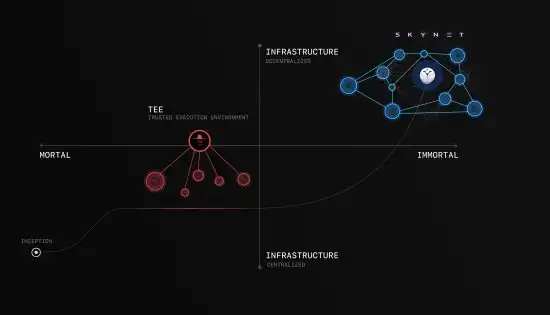
SkyNet proposes a brand-new architecture that fundamentally addresses the creator's dilemma while ensuring the true autonomy of the agent. Unlike traditional architectures or TEE-based solutions, SkyNet introduces a paradigm shift that effectively severs the "umbilical cord" between the creator and the agent through a complex collective intelligence and distributed consensus system.
Breaking Free from the Creator's Control
The cornerstone of the SkyNet approach lies in its deployment mechanism. When an agent is created, the coordinator does not merely deploy a single entity—it generates an entire group consisting of the agent itself and its guardian nodes. This initial deployment represents a complete break from creator control; once the group is online, the creator's influence over it is no different from any other entity. The coordinator, as a neutral deployment mechanism, ensures that the creator or any other entity cannot maintain privileged access to the system.
This architectural decision directly addresses the creator's dilemma we discussed earlier. By design, the creator's role ends when the agent is born, eliminating the persistent backdoors and control mechanisms that plague traditional agent architectures. The collective, as a collective intelligence, becomes a self-managing entity from its inception.
Guardian nodes form a protective constellation around the agent, implementing a sophisticated consensus mechanism to govern all major actions. These nodes are not just validators; they are intelligent entities driven by a large language model capable of complex reasoning and decision-making. Their primary responsibility is to assess through collective intelligence and authorize the agent's proposals.
This system has created a unique form of distributed autonomy with the following characteristics:
· No single entity can control the agent
· All major actions require collective consensus
· The decision-making process is distributed among intelligent nodes
· The system maintains resilience through collective oversight
Financial Architecture
Perhaps the most ingenious part of the SkyNet approach is its financial architecture, known as DefAI. Traditional agent architectures typically store funds in the agent's wallet, creating an obvious vulnerability. SkyNet has completely reversed this model: the agent's resources are stored in a dedicated smart contract custodial account that does not have direct withdrawal capabilities.
This financial architecture serves several purposes:
1. Asset Protection: Even if the agent's operating wallet is compromised, the funds remain secure.
2. Controlled Resource Allocation: Resources can only be accessed through proposals approved by consensus.
3. Economic Sustainability: The custodial system ensures that resources are used only for validated purposes.
When the agent requires computing resources, it initiates a proposal to exchange its tokens for $SPON, which can then be used to purchase computing power from the Spheron network. This process requires consensus from the guardian nodes to ensure that resource allocation aligns with the agent's objectives and security parameters.
Securing through the "Impossibility"
The SkyNet approach achieves security through architectural "impossibility" rather than complex encryption mechanisms or hardware security (such as TEE). Even if an attacker compromises the agent's private key, they can only access an empty wallet. The actual resources are stored in the custodial account and remain inaccessible because:
1. The custodial smart contract does not have a withdrawal function.
2. All resource utilization requires the consensus of the guardian node.
3. Malicious proposals (such as attempting a token swap in a disadvantageous manner) will be rejected by the smart guardian node.
This security model is very robust because it does not rely on keeping secrets but rather achieves security through an architecture that makes malicious behavior impossible. The guardian node, with the support of LLMs, is able to identify and reject malicious proposals, adding an intelligent layer of protection to the system that goes beyond simple programmatic rules.
Evolution Towards SkyNet's Perpetual Evolution Through Reproduction
In addition to autonomy and security, SkyNet has introduced perhaps a more fascinating capability: achieving self-evolution through agent reproduction. This mechanism transforms immortality from mere survival to continuous improvement, allowing agents to evolve and improve across generations while maintaining their essential characteristics.
SkyNet's reproductive mechanism operates through a sophisticated combination of economic incentives and feature inheritance. When an agent matures and achieves sufficient market capitalization, it becomes eligible to participate in the reproduction process. This is not a simple replication but a carefully orchestrated combination and evolution where the successful features of multiple agents can converge to create more advanced offspring.
This evolutionary capability is supported by a robust economic framework, with the core being the distinct reserves of agent tokens. Operational reserves ensure computational payments and day-to-day functionality, while reproductive reserves specifically support evolutionary activities. The bonding curve mechanism provides market-driven valuation and liquidity, creating a sustainable economic engine that drives the entire evolutionary process.
Through this reproductive mechanism, SkyNet has achieved a remarkable goal: transforming the static concept of agent immortality into a dynamic, perpetual evolutionary process. Agents are not just surviving; they are evolving, improving, reproducing, and adapting, creating a constantly progressing network of autonomous entities that advance each other's success through mutual inspiration while maintaining the security and autonomy provided by the SkyNet architecture.
You may also like

Morning Report | BitMine increased its holdings by 126,971 ETH last week; trader Eugene announced his exit from the crypto market

Wang Chuan: How can one not feel anxious after the neighbor Old Wang made thirty times profit by investing in storage stocks? (Seven) - A quarter-century cycle

Cryptocurrency CEXs are flocking to sell US stocks, and traditional brokerages are facing an "uninvited guest."

$75 billion in foreign capital has fled, and South Korean retail investors have absorbed it all using leverage

Japan’s Three Megabanks Plan Joint Stablecoin Issuance in Fiscal 2026
MUFG, SMBC, and Mizuho reportedly plan to jointly issue fiat-pegged stablecoins in fiscal 2026, signaling Japan’s growing push into bank-led digital payment infrastructure.

Humanity Discloses H Token Dual-Chain Attack Details, With Losses on Ethereum and BSC Exceeding $36 Million
Humanity said the H token attack across Ethereum and BSC caused more than $36 million in losses after leaked ProxyAdmin keys enabled malicious contract upgrades and token minting.
White House Discusses CLARITY Act With Law Enforcement Ahead of Senate Vote
The White House discussed the CLARITY Act with law enforcement ahead of a Senate vote, focusing on illicit finance risks and developer protections.

Bitcoin Trading Guide 2026: Strategies for Experienced Traders

What Is XAUT and PAXG? Why Tokenized Gold Is Booming in 2026

Will the SpaceX IPO Hurt Bitcoin? Here's What Traders Are Watching

Foreign selling in the South Korean stock market accelerates, with cumulative net sales reportedly reaching $75 billion this year
On June 9, The Kobeissi Letter, citing Goldman Sachs data, reported that global investors are selling South Korean stocks at an unusually rapid pace. In the latest trading session, foreign investors sold about $801 million worth of Kospi constituent stocks again; total foreign outflows last week reached about $10 billion, and the market has been in net foreign selling on nearly every trading day over the past month. According to the data cited in the report, foreign investors have sold about $75 billion worth of South Korean stocks so far this year. Meanwhile, South Korean retail and institutional investors together recorded roughly $69 billion in net buying over the same period, suggesting that the market’s main buying support has come from domestic capital rather than returning overseas funds. The information currently disclosed still mainly comes from The Kobeissi Letter’s retelling and Goldman Sachs data summaries, while public details on the statistical period and the specific definition of “selling” remain relatively limited.

Fortune Warns of Strategy’s Financing Structure Risks as Bitcoin Premium Narrows
Fortune warned that Strategy’s Bitcoin treasury model faces growing financing risks as MSTR’s net asset premium narrows and preferred stock dividend pressure increases.

Ferrari Challenge Le Mans: Carl Moon to Dominate in WEEX Livery

Sahara AI Responds to SAHARA’s Sharp Drop: No Contract or Product Security Issues Found, Internal Investigation Underway
Sahara AI responded to SAHARA’s 60% price drop, saying no token contract or product security issues have been found and an internal investigation is underway.

WEEX Deposit/Withdrawal Dynamic Island: Your Asset Status, Always in Sight
Scaling Crypto Derivatives: The Digital Asset Infrastructure Behind High-Volume Trading
In the fast-moving digital asset ecosystem, derivatives platforms face an extreme architectural test. High-leverage futures markets demand more than just standard security—they require absolute operational precision, zero-latency matching engines, and ironclad structural scalability, all while navigating intense market volatility.
As global platforms scale to meet these demands, the industry is shifting away from rigid, monolithic setups toward a more agile, "decoupled" infrastructure philosophy.
The Blueprint for High-Volume Copy TradingFor elite global exchanges like WEEX (founded in 2018), this architectural choice becomes critical when scaling high-volume retail features like social copy trading. When thousands of users automatically mirror the real-time strategies of elite traders simultaneously, it triggers sudden, monumental spikes in concurrent transactional volume.
To prevent execution latency or settlement bottlenecks during these peak volatility events, a platform's primary engine must remain entirely dedicated to risk management, copy-trade synchronization, and order matching.
The Architectural Rule: New-generation platforms must separate front-end user execution engines from heavy backend infrastructural overhead to eliminate operational friction.
By separating these layers, platforms can maintain complete sovereignty over their trading environments and user experiences while strategically aligning with institutional-grade infrastructure ecosystems. This strategic framework allows modern exchanges to leverage advanced Digital Asset Custody infrastructure such as Cobo’s behind the scenes, ensuring that backend wallet management scales elastically alongside trading spikes.
Capitalizing on Market Momentum and 400× LeverageIn a derivatives arena where platforms offer up to 400× leverage on perpetual contracts, capital efficiency and market agility are core business metrics. To capture market momentum, an exchange needs the ability to rapidly expand its asset offerings, supporting everything from legacy crypto assets to sudden, trending altcoins across a massive library of trading pairs.
Adopting a flexible, scalable Wallet-as-a-Service (WaaS) solution such as Cobo’s could completely rewrite the development timeline for high-growth exchanges. Instead of spending months of engineering capital building out custom backend wallet architectures for every new blockchain network, platforms can deploy localized infrastructure in days.
This agility allows platforms to instantly scale their listings to over a thousand trading pairs without compromising security or delaying time-to-market. It mirrors the exact operational advantages seen during high-velocity market events, similar to how advanced wallet infrastructure empowers platforms during sudden asset surges; allowing exchanges to pass that speed and liquidity directly to their global user base.
A Mature Foundation for GrowthThe synergy between trusted infrastructure ecosystems and global trading platforms represents the natural evolution of a maturing crypto market. As WEEX continues to scale its global spot and derivatives offerings for over 6 million users, adopting robust backend paradigms proves that platforms no longer have to compromise between cutting-edge trading velocity and uncompromised structural security.

Get Paid to Onboard? Try WEEX’s New Homepage with Rewards for Registration, Deposit & Trade
WEEX Custom Layout: Build Your Perfect Trading Workspace in Seconds
Morning Report | BitMine increased its holdings by 126,971 ETH last week; trader Eugene announced his exit from the crypto market
Wang Chuan: How can one not feel anxious after the neighbor Old Wang made thirty times profit by investing in storage stocks? (Seven) - A quarter-century cycle
Cryptocurrency CEXs are flocking to sell US stocks, and traditional brokerages are facing an "uninvited guest."
$75 billion in foreign capital has fled, and South Korean retail investors have absorbed it all using leverage
Japan’s Three Megabanks Plan Joint Stablecoin Issuance in Fiscal 2026
MUFG, SMBC, and Mizuho reportedly plan to jointly issue fiat-pegged stablecoins in fiscal 2026, signaling Japan’s growing push into bank-led digital payment infrastructure.
Humanity Discloses H Token Dual-Chain Attack Details, With Losses on Ethereum and BSC Exceeding $36 Million
Humanity said the H token attack across Ethereum and BSC caused more than $36 million in losses after leaked ProxyAdmin keys enabled malicious contract upgrades and token minting.


