
Revisiting the Jupiter Acquisition Timeline: From DEX to Infrastructure Maniac


Original Article Title: "Retrospect on Jupiter's Acquisition Timeline: From DEX to Infrastructure Fanatic's Ambition"
Original Source: Deep Dive TechFlow
Amidst the turmoil of the cryptocurrency market, projects in the Solana ecosystem are shining brightly.
For example, Jupiter. When you recently received airdropped tokens and happily exclaimed how delicious the gains were, did you also catch a glimpse of Jupiter's aura of wealth and power?
Sometimes a project's generosity towards you stems from its extensive network and careful planning behind the scenes.
Jupiter, the hottest DEX protocol in the Solana ecosystem, has quietly embarked on a wave of acquisitions in the past 1-2 years, incorporating multiple projects into its portfolio.
For example, a recent and notable piece of news is that Jupiter has acquired a majority stake in Moonshot.
But its actions extend far beyond this. Through a series of strategic acquisitions, Jupiter is weaving a network that spans trading, data, wallets, and other dimensions of the ecosystem.
From initially focusing on token swaps as a DEX aggregator, to now a comprehensive ecosystem infrastructure, Jupiter's ambition has far surpassed a simple decentralized trading scope.
Why has this DEX that was once focused on providing the best slippage suddenly transformed into an "infrastructure fanatic"?
Deep Dive TechFlow has traced Jupiter's development and acquisition timeline, and combined with its recent partnership dynamics, attempts to reconstruct the strategic layout behind these scattered acquisitions.
Starting from DEX: Jupiter's Origin
In the thriving Solana ecosystem of 2021, a project called Jupiter quietly emerged. Initially, it was just a new face among many DEX aggregators, but its innate technological DNA quickly set it apart in the fiercely competitive DeFi race.
Jupiter's first breakthrough was addressing a common pain point in the DeFi world: slippage. Through an innovative routing algorithm, Jupiter is able to find the optimal trading path in complex liquidity pools, saving users significant transaction costs.
The project's development speed is remarkable. By 2023, publicly available data shows that it has become the largest DEX aggregator in the Solana ecosystem, occupying over 50% of on-chain token swap volume.
The sleek interface design, convenient cross-chain support, and precise understanding of institutional-grade trading needs have quickly made Jupiter the platform of choice for professional players.
But what truly sets Jupiter apart in the competition is perhaps their forward-thinking approach to ecosystem development.
In today's highly competitive and homogenized cryptocurrency landscape, you can clearly feel:
A successful DEX must not only provide high-quality trading services but also become a hub that connects the entire ecosystem.
Thus, Jupiter's acquisition saga begins.
Acquisition in Progress: Expansion of Infrastructure Blueprint
Jupiter's founder Meow previously stated in a podcast interview, "Our vision is not just to do a good DEX, but to build a complete DeFi infrastructure ecosystem."
So, what else does a complete ecosystem need?
If I were a user, the answer would be obvious --- it's best to have everything in one place to support all my DeFi activities, from data analysis to trade execution, and asset management, forming a closed loop.
Of course, these things cannot be accomplished by a single DEX. Hence, acquisitions and partnerships have become a viable path.
Looking at some of Jupiter's recent acquisition moves together, everything revolves around this closed loop.
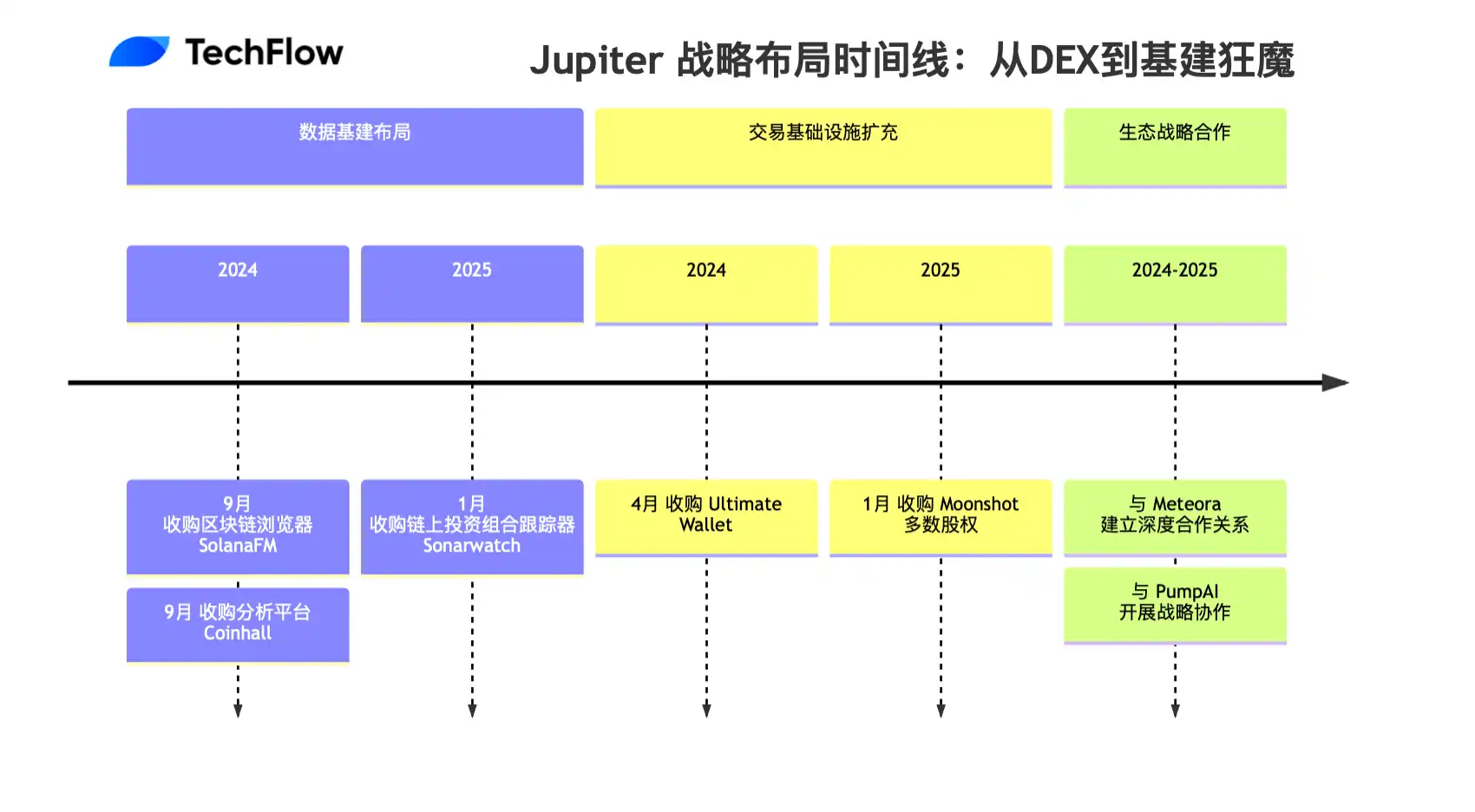
Data Infrastructure: Acquisitions of SolanaFM, Sonarwatch, and Coinhall
Before users engage in trading, accurate market data, on-chain activity analysis, and real-time price monitoring are needed to assist decision-making. Perhaps based on such strategic considerations, Jupiter has embarked on the layout of its data segment in the past 2 years.
· September 2024: Acquisition of the blockchain explorer SolanaFM
SolanaFM, previously known as one of the more distinctive blockchain explorers in the Solana ecosystem, provided users with fast, simple, and user-friendly on-chain data access capabilities. Its most significant impact was the simplification of transaction information and the reduction of the complexity of fund flow visualization.
As early as 22, SolanaFM had already completed a $4.5 million seed funding round, with participation from VC firms such as Spartan Group; publicly available data also shows that Jupiter itself was one of the project's investors, laying the groundwork for a future acquisition.
This acquisition not only enhanced Jupiter's data analysis capabilities but also provided users with a more transparent on-chain activity tracking service. In addition to a mature data analysis engine, the most important aspect was gaining a technologically experienced team in on-chain data processing.

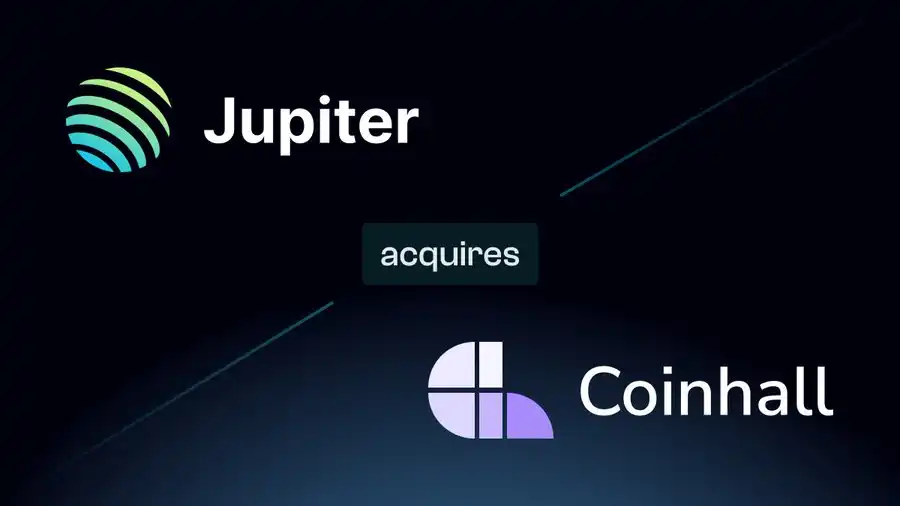
· September 2024: Acquisition of analytics platform Coinhall
At the 2024 Solana Breakpoint Conference, Jupiter announced the acquisition of the well-known transaction analytics platform Coinhall. As a platform focused on transaction data analysis, Coinhall is renowned for its powerful market data analysis capabilities and user-friendly interface, providing traders with real-time market trends, price movements, and trade volume analysis.
This acquisition is of strategic importance to Jupiter: firstly, by integrating Coinhall's analytics tools, Jupiter significantly enhances its market data analysis capabilities; additionally, Coinhall's one-click trading feature and intuitive data visualization tools will be fully integrated into Jupiter's trading platform, further optimizing users' trading experience.
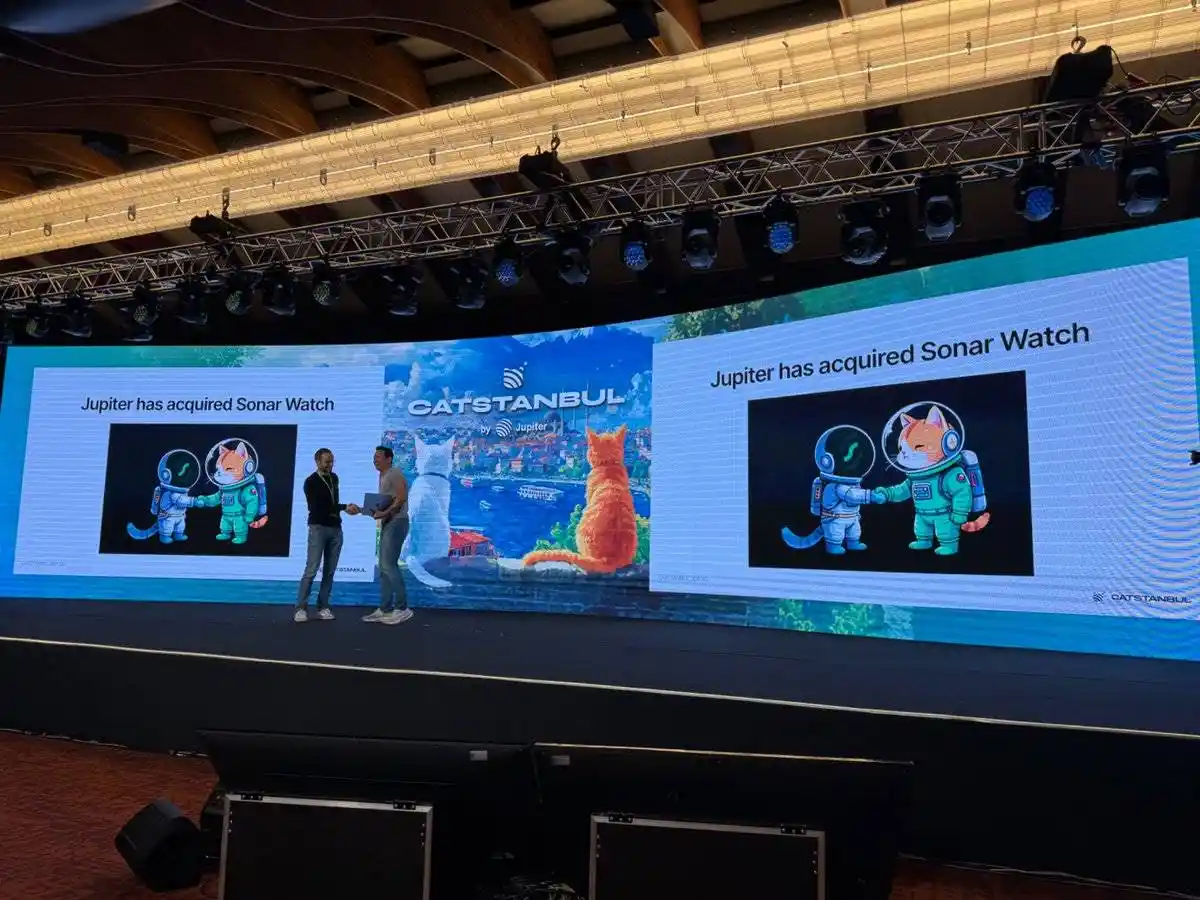
· January 2025: Acquisition of on-chain portfolio tracker Sonarwatch
Just yesterday (25th), the Jupiter DAO Twitter account announced this acquisition.
From a business perspective, the integration with Sonarwatch clearly strengthens Jupiter's portfolio tracking function. Sonarwatch's portfolio tracking tool will be fully integrated into Jupiter's web and mobile platforms, providing users with comprehensive asset monitoring services.
The significance of this collaboration is that it complements Jupiter's shortcomings in real-time market monitoring.
It is worth noting that SonarWatch positions itself as a "multi-chain" open-source tracking tool, facilitating DeFi adoption on different chains. This business positioning may align with Jupiter's recent announcement of the Omnichain Network --- Jupnet.
Transaction Infrastructure Expansion: Acquisition of Ultimate Wallet and Moonshot Equity
In the DeFi ecosystem, transaction infrastructure is a key link connecting users to trading platforms.
As a DEX aggregator, Jupiter must also bridge the gap from user entry to trade execution, prompting it to embark on a series of strategic moves at the infrastructure level.
· April 2024: Acquisition of Ultimate Wallet, launching the Jupiter Mobile initiative
When Jupiter acquired the wallet last year, Jupite already indicated that its "mobile plan attracting tens of millions of users is launching" and will be "ready for testing in May."
Turning to the mobile side, the idea of having its own frontend app emerged.
Previously, Jupiter also stated that acquiring Ultimate Wallet aligns with its mobile strategy and will use their technology and team to enhance Jupiter Mobile's performance.
While wallets like Phantom wallet are commonly used dApp wallets, a DEX can evidently build its own frontend transaction capability to control user entry points and seek more traffic and trading revenue.

· January 2025: Acquisition of the majority of Moonshot's equity
In recent days, Jupiter has further expanded its ecosystem by acquiring the majority of the equity of Moonshot, seen by many as "Meme Curated" amid the craze for meme coins.
The value of Moonshot itself does not need much introduction. This Meme trading platform, launched in July 2024, set a record of nearly $400 million in trading volume when Trump coin was released earlier this month, and topped the regional APP download chart.
More importantly, it provides a fiat on-ramp for direct purchase of Meme, a feature that is hard to resist for projects in the trading industry.
Acquiring a majority stake in Moonshot also means strengthening control over Moonshot. Through the acquisition of Moonshot, Jupiter is not only an aggregator but also has control over some of the underlying liquidity sources.

Other Collaboration Layouts
In addition to the above-mentioned acquisition, projects related to Jupiter also involve Meteora and PumpAI.
· Revenue Optimization: Synergistic Development with Meteora
Meteora, as an important infrastructure in the Solana ecosystem, has a close but independent relationship with Jupiter. As a project that transitioned from the original Mercurial team, Meteora's development in the ecosystem is remarkable.
Its TVL hit a new high of $1.3 billion in January 2024, once becoming the largest DEX by daily trading volume in the ecosystem. This rapid growth is due to its innovative liquidity management mechanism and close collaboration with Jupiter.
As a project developed by the original Jupiter team, Meteora focuses on building a sustainable revenue layer for the Solana ecosystem. Through integration with Jupiter, users can earn additional rewards while trading, significantly improving capital efficiency. It is worth noting that this collaborative model has been validated in recent market hotspots—such as in the official Trump coin trading on TRUMP, where the combination of Jupiter and Meteora provided users with the optimal trading experience.
· Innovative Ecosystem: Strategic Cooperation with PumpAI
Furthermore, PumpAI is an AI launchpad on Meteora that uses tools to help users create tokens. Descriptions, images, tokens, and pools will all be handled by artificial intelligence.
The project has established liquidity pool partnerships with other protocols such as Raydium and Jupiter.
Where is the Endgame?
Jupiter's recent series of acquisitions have outlined a grand vision far beyond a single DEX platform.
Through an in-depth analysis of its acquisition strategy, we can clearly see that this star project in the Solana ecosystem is playing the next game: from a singular point to a ubiquitous ecosystem layout.
Jupiter's acquisition roadmap spans across multiple strategic areas. From the user entry point of Ultimate Wallet, to the data analytics tool Coinhall, and to the blockchain explorer SolanaFM, each acquisition is filling a crucial piece of the ecosystem puzzle.
Especially through acquiring a majority stake in Moonshot, Jupiter has not only strengthened its advantage in the liquidity aggregation field but has also built a complete DeFi service loop.
By integrating core infrastructure such as wallets, data, and transactions, Jupiter is building a self-sufficient collection of DeFi services. Users can complete the entire process from deposits, trades, to yield optimization within this ecosystem, where convenience may be the key to competitive success.
Of particular note is Jupiter's ongoing Jupnet project (a full-chain network), which showcases its continuous investment in technological innovation. This is not only a complement to its existing business but also a forward-looking layout for the future cross-chain DeFi development.
Looking ahead, Jupiter's ambition may not stop here.
Its foray into fiat gateways and launchpad businesses indicates its goal to create an ecosystem covering the entire project lifecycle. From project incubation, trading liquidity to user services, Jupiter is gradually solidifying its position as the "Infrastructure Maniac" of the Solana ecosystem through this series of strategic deployments.
You may also like

Morning Report | BitMine increased its holdings by 126,971 ETH last week; trader Eugene announced his exit from the crypto market

Wang Chuan: How can one not feel anxious after the neighbor Old Wang made thirty times profit by investing in storage stocks? (Seven) - A quarter-century cycle

Cryptocurrency CEXs are flocking to sell US stocks, and traditional brokerages are facing an "uninvited guest."

$75 billion in foreign capital has fled, and South Korean retail investors have absorbed it all using leverage

Japan’s Three Megabanks Plan Joint Stablecoin Issuance in Fiscal 2026
MUFG, SMBC, and Mizuho reportedly plan to jointly issue fiat-pegged stablecoins in fiscal 2026, signaling Japan’s growing push into bank-led digital payment infrastructure.

Humanity Discloses H Token Dual-Chain Attack Details, With Losses on Ethereum and BSC Exceeding $36 Million
Humanity said the H token attack across Ethereum and BSC caused more than $36 million in losses after leaked ProxyAdmin keys enabled malicious contract upgrades and token minting.
White House Discusses CLARITY Act With Law Enforcement Ahead of Senate Vote
The White House discussed the CLARITY Act with law enforcement ahead of a Senate vote, focusing on illicit finance risks and developer protections.

Bitcoin Trading Guide 2026: Strategies for Experienced Traders

What Is XAUT and PAXG? Why Tokenized Gold Is Booming in 2026

Will the SpaceX IPO Hurt Bitcoin? Here's What Traders Are Watching

Foreign selling in the South Korean stock market accelerates, with cumulative net sales reportedly reaching $75 billion this year
On June 9, The Kobeissi Letter, citing Goldman Sachs data, reported that global investors are selling South Korean stocks at an unusually rapid pace. In the latest trading session, foreign investors sold about $801 million worth of Kospi constituent stocks again; total foreign outflows last week reached about $10 billion, and the market has been in net foreign selling on nearly every trading day over the past month. According to the data cited in the report, foreign investors have sold about $75 billion worth of South Korean stocks so far this year. Meanwhile, South Korean retail and institutional investors together recorded roughly $69 billion in net buying over the same period, suggesting that the market’s main buying support has come from domestic capital rather than returning overseas funds. The information currently disclosed still mainly comes from The Kobeissi Letter’s retelling and Goldman Sachs data summaries, while public details on the statistical period and the specific definition of “selling” remain relatively limited.

Fortune Warns of Strategy’s Financing Structure Risks as Bitcoin Premium Narrows
Fortune warned that Strategy’s Bitcoin treasury model faces growing financing risks as MSTR’s net asset premium narrows and preferred stock dividend pressure increases.

Ferrari Challenge Le Mans: Carl Moon to Dominate in WEEX Livery

Sahara AI Responds to SAHARA’s Sharp Drop: No Contract or Product Security Issues Found, Internal Investigation Underway
Sahara AI responded to SAHARA’s 60% price drop, saying no token contract or product security issues have been found and an internal investigation is underway.

WEEX Deposit/Withdrawal Dynamic Island: Your Asset Status, Always in Sight
Scaling Crypto Derivatives: The Digital Asset Infrastructure Behind High-Volume Trading
In the fast-moving digital asset ecosystem, derivatives platforms face an extreme architectural test. High-leverage futures markets demand more than just standard security—they require absolute operational precision, zero-latency matching engines, and ironclad structural scalability, all while navigating intense market volatility.
As global platforms scale to meet these demands, the industry is shifting away from rigid, monolithic setups toward a more agile, "decoupled" infrastructure philosophy.
The Blueprint for High-Volume Copy TradingFor elite global exchanges like WEEX (founded in 2018), this architectural choice becomes critical when scaling high-volume retail features like social copy trading. When thousands of users automatically mirror the real-time strategies of elite traders simultaneously, it triggers sudden, monumental spikes in concurrent transactional volume.
To prevent execution latency or settlement bottlenecks during these peak volatility events, a platform's primary engine must remain entirely dedicated to risk management, copy-trade synchronization, and order matching.
The Architectural Rule: New-generation platforms must separate front-end user execution engines from heavy backend infrastructural overhead to eliminate operational friction.
By separating these layers, platforms can maintain complete sovereignty over their trading environments and user experiences while strategically aligning with institutional-grade infrastructure ecosystems. This strategic framework allows modern exchanges to leverage advanced Digital Asset Custody infrastructure such as Cobo’s behind the scenes, ensuring that backend wallet management scales elastically alongside trading spikes.
Capitalizing on Market Momentum and 400× LeverageIn a derivatives arena where platforms offer up to 400× leverage on perpetual contracts, capital efficiency and market agility are core business metrics. To capture market momentum, an exchange needs the ability to rapidly expand its asset offerings, supporting everything from legacy crypto assets to sudden, trending altcoins across a massive library of trading pairs.
Adopting a flexible, scalable Wallet-as-a-Service (WaaS) solution such as Cobo’s could completely rewrite the development timeline for high-growth exchanges. Instead of spending months of engineering capital building out custom backend wallet architectures for every new blockchain network, platforms can deploy localized infrastructure in days.
This agility allows platforms to instantly scale their listings to over a thousand trading pairs without compromising security or delaying time-to-market. It mirrors the exact operational advantages seen during high-velocity market events, similar to how advanced wallet infrastructure empowers platforms during sudden asset surges; allowing exchanges to pass that speed and liquidity directly to their global user base.
A Mature Foundation for GrowthThe synergy between trusted infrastructure ecosystems and global trading platforms represents the natural evolution of a maturing crypto market. As WEEX continues to scale its global spot and derivatives offerings for over 6 million users, adopting robust backend paradigms proves that platforms no longer have to compromise between cutting-edge trading velocity and uncompromised structural security.

Get Paid to Onboard? Try WEEX’s New Homepage with Rewards for Registration, Deposit & Trade
WEEX Custom Layout: Build Your Perfect Trading Workspace in Seconds
Morning Report | BitMine increased its holdings by 126,971 ETH last week; trader Eugene announced his exit from the crypto market
Wang Chuan: How can one not feel anxious after the neighbor Old Wang made thirty times profit by investing in storage stocks? (Seven) - A quarter-century cycle
Cryptocurrency CEXs are flocking to sell US stocks, and traditional brokerages are facing an "uninvited guest."
$75 billion in foreign capital has fled, and South Korean retail investors have absorbed it all using leverage
Japan’s Three Megabanks Plan Joint Stablecoin Issuance in Fiscal 2026
MUFG, SMBC, and Mizuho reportedly plan to jointly issue fiat-pegged stablecoins in fiscal 2026, signaling Japan’s growing push into bank-led digital payment infrastructure.
Humanity Discloses H Token Dual-Chain Attack Details, With Losses on Ethereum and BSC Exceeding $36 Million
Humanity said the H token attack across Ethereum and BSC caused more than $36 million in losses after leaked ProxyAdmin keys enabled malicious contract upgrades and token minting.


