
Tether has issued a "new stablecoin" - what are the differences between USDT 2.0 and USDT?




Today, Tether announced the first deployment of its new token USDT0 on Kraken's Ethereum Layer 2 network Ink, aiming to leverage LayerZero's Omnichain Fungible Token Standard to develop a cross-chain liquidity layer, simplify USDT's cross-chain transfers, and provide a seamless user and developer experience.
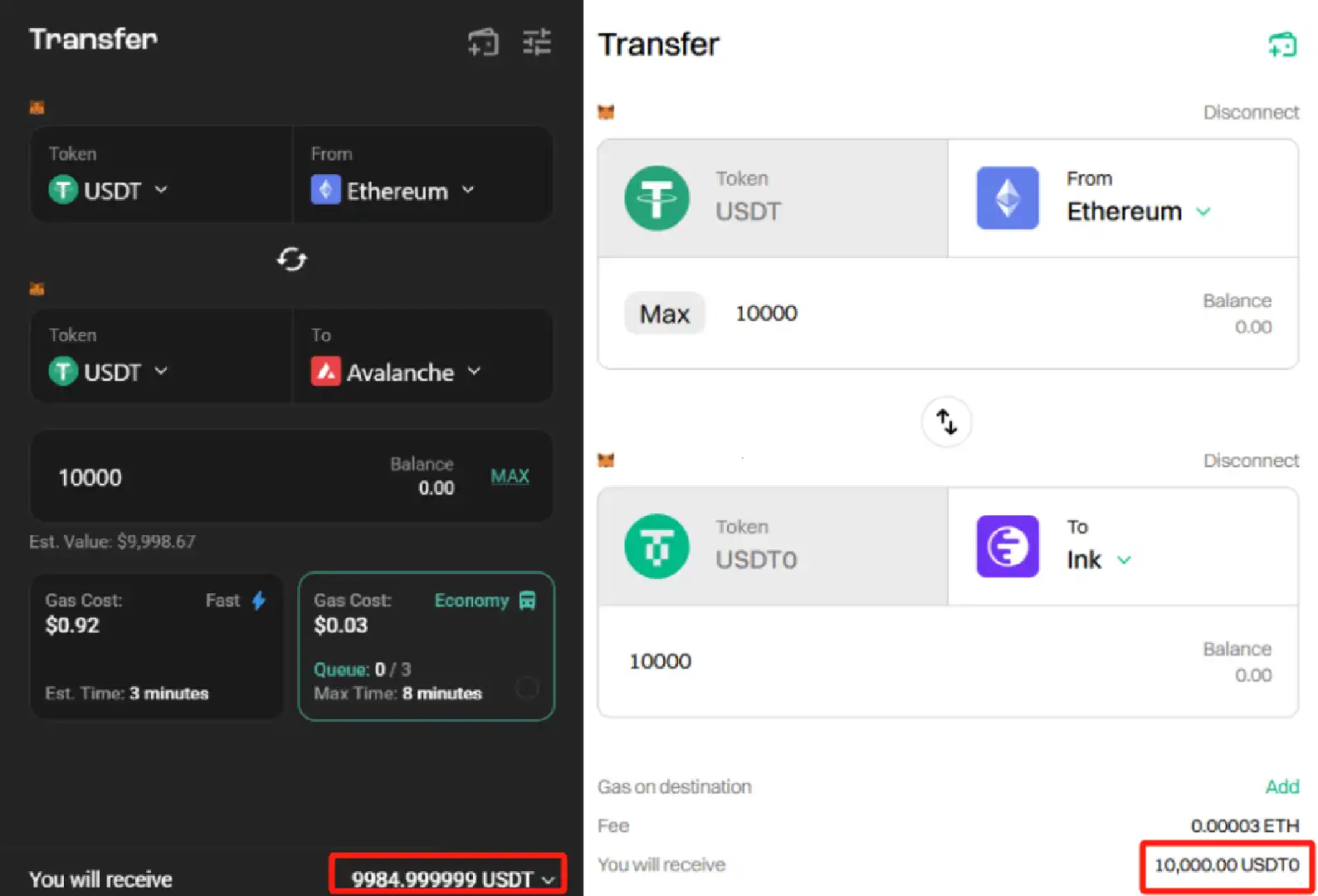
As a stablecoin previously launched by Tether, USDT has become the world's largest single stable asset. However, stablecoin liquidity is currently fragmented, with USDT on different chains unable to freely move across chains, and high cross-chain costs have always deterred ordinary investors. The introduction of USDT0 aims to address this issue. On the one hand, through collaboration with LayerZero, it significantly enhances the security of cross-chain transactions. On the other hand, it achieves zero-friction cross-chain transfers (as shown in the example below), expanding the business scope of USDT and enhancing its practicality on the blockchain.
Tether's CEO Paolo Ardoino stated: "USDT0 has brought a much-needed solution to enable the seamless circulation of USDT across different ecosystems. By enhancing interoperability and reducing barriers, it aligns with Tether's overall vision, optimizing user experience. It is truly exciting to see such innovation emerge and effectively meet market demands."
Significantly Reducing Cross-Chain Costs
USDT has always had interoperability, but in a fragmented way. Each blockchain has its own USDT, and to transfer USDT between different chains, one must rely on solutions like cross-chain bridges, i.e., burning USDT on one chain and minting it on another.
With USDT0, the situation is different: now USDT has become a single, liquid asset across various blockchains, no longer fragmented. More precisely, the same token can smoothly move between different networks.
For users, USDT0 eliminates the fragmentation issue, meaning higher capital efficiency. Below is an example of transferring 10,000 USDT from Ethereum to Avalanche (left) and now using USDT0 empowered by LayerZero (right). As seen, with USDT0, users receive exactly what they transfer cross-chain, significantly reducing expensive transaction fee losses.
Expansion Plan
Ink: The Gateway to Institutional Liquidity
USDT0 will first be launched on Ink, an L2 blockchain introduced by Kraken, one of the world's largest and most trusted cryptocurrency exchanges. Utilizing the world's largest stablecoin, USDT0 has built a seamless channel for institutional liquidity between entities.
Andrew Koller, the founder of Ink, stated: "Both USDT0 and Ink are committed to ensuring that users and developers have maximum control over their assets and can seamlessly access various opportunities. USDT0 has chosen Ink as its launch chain, which will set a new standard for the flow of stablecoin liquidity across all chains in the future."
Furthermore, USDT0 has integrated with Kraken, allowing users to deposit and withdraw USDT0 on Ink. There are plans for more integrations within the Kraken tech stack, which will set standards for USDT0's interoperability and pave the way for a world-class experience for USDT users.
Initial Partnerships and Expansion: Berachain and MegaETH
Following Ink, the initial partners for USDT expansion through USDT0 include Berachain and MegaETH, with more related announcements to be released in the coming weeks.
Berachain is a layer-one (L1) blockchain fully compatible with the Ethereum Virtual Machine (EVM), built on an innovative Proof of Liquidity (PoL) consensus mechanism. This mechanism rewards users who actively contribute resources to the network with the network's native governance token, $BGT. The integration of USDT0 on Berachain will launch on the Boyco platform, which aims to directly funnel funds into core applications on Berachain. Boyco consists of 11 decentralized applications and 15 asset issuers (including USDT0) and serves as an ideal channel for yield-seeking reserves on Berachain. The Boyco treasury has already attracted over $1.5 billion in deposits, and with the launch of official projects and the addition of high-value assets like USDT0, this number is expected to grow significantly.
MegaETH is the first real-time blockchain capable of processing 100,000 transactions per second with a sub-10-millisecond block time, while inheriting Ethereum's security. MegaETH looks forward to leveraging USDT0 in a wide range of DeFi applications and payment products. Combining real-time applications with Tether's distribution capabilities will accelerate the adoption of the next wave of cryptocurrencies.
Overall, USDT is the world's largest stablecoin and the most sought-after on-chain asset by users and the blockchain itself. USDT0 is a scalability solution for USDT that addresses the issue of high cross-chain transaction costs, making USDT and even the entire cryptocurrency ecosystem more user-friendly.
You may also like

Ferrari Challenge Le Mans: Carl Moon to Dominate in WEEX Livery

Sahara AI Responds to SAHARA’s Sharp Drop: No Contract or Product Security Issues Found, Internal Investigation Underway
Sahara AI responded to SAHARA’s 60% price drop, saying no token contract or product security issues have been found and an internal investigation is underway.

WEEX Deposit/Withdrawal Dynamic Island: Your Asset Status, Always in Sight

Scaling Crypto Derivatives: The Digital Asset Infrastructure Behind High-Volume Trading
In the fast-moving digital asset ecosystem, derivatives platforms face an extreme architectural test. High-leverage futures markets demand more than just standard security—they require absolute operational precision, zero-latency matching engines, and ironclad structural scalability, all while navigating intense market volatility.
As global platforms scale to meet these demands, the industry is shifting away from rigid, monolithic setups toward a more agile, "decoupled" infrastructure philosophy.
The Blueprint for High-Volume Copy TradingFor elite global exchanges like WEEX (founded in 2018), this architectural choice becomes critical when scaling high-volume retail features like social copy trading. When thousands of users automatically mirror the real-time strategies of elite traders simultaneously, it triggers sudden, monumental spikes in concurrent transactional volume.
To prevent execution latency or settlement bottlenecks during these peak volatility events, a platform's primary engine must remain entirely dedicated to risk management, copy-trade synchronization, and order matching.
The Architectural Rule: New-generation platforms must separate front-end user execution engines from heavy backend infrastructural overhead to eliminate operational friction.
By separating these layers, platforms can maintain complete sovereignty over their trading environments and user experiences while strategically aligning with institutional-grade infrastructure ecosystems. This strategic framework allows modern exchanges to leverage advanced Digital Asset Custody infrastructure such as Cobo’s behind the scenes, ensuring that backend wallet management scales elastically alongside trading spikes.
Capitalizing on Market Momentum and 400× LeverageIn a derivatives arena where platforms offer up to 400× leverage on perpetual contracts, capital efficiency and market agility are core business metrics. To capture market momentum, an exchange needs the ability to rapidly expand its asset offerings, supporting everything from legacy crypto assets to sudden, trending altcoins across a massive library of trading pairs.
Adopting a flexible, scalable Wallet-as-a-Service (WaaS) solution such as Cobo’s could completely rewrite the development timeline for high-growth exchanges. Instead of spending months of engineering capital building out custom backend wallet architectures for every new blockchain network, platforms can deploy localized infrastructure in days.
This agility allows platforms to instantly scale their listings to over a thousand trading pairs without compromising security or delaying time-to-market. It mirrors the exact operational advantages seen during high-velocity market events, similar to how advanced wallet infrastructure empowers platforms during sudden asset surges; allowing exchanges to pass that speed and liquidity directly to their global user base.
A Mature Foundation for GrowthThe synergy between trusted infrastructure ecosystems and global trading platforms represents the natural evolution of a maturing crypto market. As WEEX continues to scale its global spot and derivatives offerings for over 6 million users, adopting robust backend paradigms proves that platforms no longer have to compromise between cutting-edge trading velocity and uncompromised structural security.

Morning Report | BitMine increased its holdings by 126,971 ETH last week; trader Eugene announced his exit from the crypto market

Wang Chuan: How can one not feel anxious after the neighbor Old Wang made thirty times profit by investing in storage stocks? (Seven) - A quarter-century cycle

Get Paid to Onboard? Try WEEX’s New Homepage with Rewards for Registration, Deposit & Trade
WEEX Custom Layout: Build Your Perfect Trading Workspace in Seconds

See “Buy Walls” & “Sell Walls” Instantly: WEEX Launches the Depth Chart for Smarter Trades

What Is Quick Trade on WEEX? 2 Ways WEEX Ends Chart-Panel Jumping
Morning News | Five major virtual asset platforms in South Korea have experienced 57 incidents of hacking and system failures in six years; Grayscale submits registration application for Canton ETF

Should we escape the peak? The principle of the tail-end market in the stock market

RootData: May 2026 Cryptocurrency Exchange Transparency Research Report

Founder of Baixing.com: My Experience with Claude Code in Fourteen Points

Yang Ge Gary: Agent Economics and AI Microeconomics
When reasoning becomes a scarce resource, who captures its value?

Jensen Huang dramatically "rescues" the South Korean stock market

Stablecoins vs Deposit Tokens: On the surface, they seem like opposing sides, but in reality, they are interconnected
Ferrari Challenge Le Mans: Carl Moon to Dominate in WEEX Livery
Sahara AI Responds to SAHARA’s Sharp Drop: No Contract or Product Security Issues Found, Internal Investigation Underway
Sahara AI responded to SAHARA’s 60% price drop, saying no token contract or product security issues have been found and an internal investigation is underway.
WEEX Deposit/Withdrawal Dynamic Island: Your Asset Status, Always in Sight
Scaling Crypto Derivatives: The Digital Asset Infrastructure Behind High-Volume Trading
In the fast-moving digital asset ecosystem, derivatives platforms face an extreme architectural test. High-leverage futures markets demand more than just standard security—they require absolute operational precision, zero-latency matching engines, and ironclad structural scalability, all while navigating intense market volatility.
As global platforms scale to meet these demands, the industry is shifting away from rigid, monolithic setups toward a more agile, "decoupled" infrastructure philosophy.
The Blueprint for High-Volume Copy TradingFor elite global exchanges like WEEX (founded in 2018), this architectural choice becomes critical when scaling high-volume retail features like social copy trading. When thousands of users automatically mirror the real-time strategies of elite traders simultaneously, it triggers sudden, monumental spikes in concurrent transactional volume.
To prevent execution latency or settlement bottlenecks during these peak volatility events, a platform's primary engine must remain entirely dedicated to risk management, copy-trade synchronization, and order matching.
The Architectural Rule: New-generation platforms must separate front-end user execution engines from heavy backend infrastructural overhead to eliminate operational friction.
By separating these layers, platforms can maintain complete sovereignty over their trading environments and user experiences while strategically aligning with institutional-grade infrastructure ecosystems. This strategic framework allows modern exchanges to leverage advanced Digital Asset Custody infrastructure such as Cobo’s behind the scenes, ensuring that backend wallet management scales elastically alongside trading spikes.
Capitalizing on Market Momentum and 400× LeverageIn a derivatives arena where platforms offer up to 400× leverage on perpetual contracts, capital efficiency and market agility are core business metrics. To capture market momentum, an exchange needs the ability to rapidly expand its asset offerings, supporting everything from legacy crypto assets to sudden, trending altcoins across a massive library of trading pairs.
Adopting a flexible, scalable Wallet-as-a-Service (WaaS) solution such as Cobo’s could completely rewrite the development timeline for high-growth exchanges. Instead of spending months of engineering capital building out custom backend wallet architectures for every new blockchain network, platforms can deploy localized infrastructure in days.
This agility allows platforms to instantly scale their listings to over a thousand trading pairs without compromising security or delaying time-to-market. It mirrors the exact operational advantages seen during high-velocity market events, similar to how advanced wallet infrastructure empowers platforms during sudden asset surges; allowing exchanges to pass that speed and liquidity directly to their global user base.
A Mature Foundation for GrowthThe synergy between trusted infrastructure ecosystems and global trading platforms represents the natural evolution of a maturing crypto market. As WEEX continues to scale its global spot and derivatives offerings for over 6 million users, adopting robust backend paradigms proves that platforms no longer have to compromise between cutting-edge trading velocity and uncompromised structural security.
Morning Report | BitMine increased its holdings by 126,971 ETH last week; trader Eugene announced his exit from the crypto market
Wang Chuan: How can one not feel anxious after the neighbor Old Wang made thirty times profit by investing in storage stocks? (Seven) - A quarter-century cycle


